Showing posts with label chickens. Show all posts

Saturday, April 23, 2011

Born to be Wild

This one's for Hoosier Sue, with my apologies.


Chickens are domestic animals, we're quite certain, but that turns out to cover a range of possible behaviors. To pervert George Orwell a bit, some are more domestic than others.


Araucanas are "others" in that classification. I like them because they represent a breed that is closer somehow to the original species of chicken, and I admire their hardiness, fearless personalities, and attractive coloring (bird and egg). They are not pure white nor bred to be egg-laying machines with feathers, as Leghorns are. They are themselves, and they go about their business in their own ways.

Here I should digress a minute to explain that there's some controversy over the use of "Araucana." Araucanas are like yams, apparently, in that they do not truly occur in the U.S. and what we simplistically call Araucanas are more properly known as Ameraucanas, or "Easter-eggers." Also spelled Americanas, so we've recently settled on the nickname A'cana to cover all our bases.


In any case, when HS asked for a recommendation on chicken breeds, I heartily endorsed A'canas out of my fondness for them. Perhaps she should have asked the Husband, who remembers (though he didn't mention it last year when I brought home eight A'cana chicks) that this breed also offers difficulties.


Trusting me, HS acquired a mixed flock of Barred Plymouth Rocks (a wonderful, and highly domestic bird) and A'canas. Her chicks are lovely... and one of them, a Barred Rock, soon showed that he would not be contributing to her supply of fresh eggs. The chicks are 7 weeks old now, and a few days ago she reported this story:

I'm in the kitchen and hear this "Errr Err" and think, "What the %^&*(?"


And then it dawns on me.


And then another one. Better. Louder. Errrrrrr Errrr


At least he waited until 7:30 a.m.


"Lt. Worf" as she calls him, the name revealing how early the effects of testosterone show up, is hand-tamed and sweet... so far. We are hoping for the best.


But back to our story.


Where the Grass is Greener

The difficulties with A'canas became apparent this spring. Fully feathered and full-grown now, these chickens began to appear in places we're not used to seeing them. Dangerous places: In the backyard, where the dogs hang out; on rooftop of the coop; and in the front yard. Daily now, we can expect them to 'fly the coop.' What was initially cause for panic has now become routine: clear the backyard of chickens before letting Dog #1 out the door. Dog #2 seems to be congenial to the escapee.


Last week, we discovered WHY she's developed such fondness for the backyard. The Husband found a clutch of 7 beautiful green eggs under the big juniper. Now we understand—a safe place (out of reach of skunks who have been enjoying 'hen fruit' in the coop daily of late) where, she clearly hoped, we wouldn't keep stealing the results of her labor. She was wrong about the latter, but she still finds her way over the fence every time she gets the urge to lay an egg. At least now we know where to look for them!


Before I let the chicken-killer dog loose, I check the back fence. If I find an A'cana pacing back and forth, waiting to be allowed back into the chicken yard, I open the gate, and she happily rushes home to the food dish. Her self-powered escapades are one-way only.


Not so our front yard bird. She has now perfected the art of escaping and returning as often as she likes.


Tuesday, March 08, 2011

Fowl Weather*

Dire predictions for weather here these last few days have uniformly failed to materialize. That's unusual for March, storms of which routinely produce whatever snow piles are forecast. We woke today to a proper pea soup of fog, as yesterday, but only a skim of white crystals has reached the ground. For the life of me, I can't find the camera, but it looks a lot like this out there, minus the heavy snow.

(Ah, ha! You have only to retrace your steps, and remember that you were trying to snap the lovely crystals on the gate, without success, then came in by the fire, and voila! Here's this morning's actual view.)

It's produced a nice feathered frosting of white on everything, one of the occasional attractions winter provides. Even the chain link gate to the chicken yard looks like a piece of delicate lace...


And the trees! Yesterday I attended a 1 p.m. meeting atop Lookout Mtn, which was in dense fog. The storm, scheduled to move in at 2 p.m., made us hurry through the meeting, but we left in dense fog and clear roads, allowing a view of white-laced trees. Much like this view from February 25th, only a mountain away, but with the ground whitened as well.

Anyway, the point of all this was to talk about chickens. My friend at the Hoosier Horse Farm took a whim in the chicken direction recently, and has been entertaining me with questions and, now that she has her chicks, reactions.

First, a debate on "what kind"... answered in favor of Barred Plymouth Rocks and Ameraucanas (aka "Easter Eggers"). Then the excitement of fluffy little bits of incipient chickenhood at home—"You didn't tell me they'd be so much fun to watch!"

(They aren't nearly so pink, but it is hard to get good photos in indoor light. The 'Canas are the ones that look like chipmunks... very cute!)

The first night she made coffee and stayed up to watch them. First they run around pecking, then they drop, wherever they find themselves, down for a nap, then up and down... Chicken TV. (Networks take notice.) It's especially entertaining to watch them drink.

Last night an update arrived: "They double in size every 12 hours! They are bored... they can fly." (She also mentioned poopy and smelly.) Uh, oh... now she'll be in a race to get them outdoor housing. All too soon, they'll look a little like this photo of our 2008 batch, miniature adults.

Months later, eggs will start arriving. A regular reader wants to know what green eggs look like: here's the answer. (See, we do requests, eventually, here at Foothills Fancies.) It's a good thing she only got 7 chicks—she might be able to keep up!

I have nine (9) dozen eggs in the fridge as I write this, and have just eaten two (one brown, one green) for breakfast. (Not two dozen.) I gave some to Cat Woman (giving them to everyone these days...); she's the only one I know who has been able to distinguish the green eggs from brown; she says they give her indigestion!

I'm finding eggs all over in the coop; last night I even stepped on one, much to the appreciation of the three hens that hurried over to clean it up. This rate, with Easter still six weeks away, is a little alarming. But it won't last...


* Forgive me that one...

Tuesday, January 18, 2011

How to Start a Year

So far, 2011 has shown promise, in its small moments and quiet observations. Just the way we like it here at FF... Dawn photo, on the 2nd, finds the Sun in its notch, already a bit to the north of its Winter Solstice position.

Our New Year's storm was followed by an even more productive one the next weekend. So far, we are two for three on weekend snow. With temperatures plus-50F (above 10C) this past weekend (and a few minutes of actual rain, in January yet, yesterday morning), the entire foot (30 cm) of snow is now also gone. On January 6th, the calm between the storms is reflected in a pink morning.

Trips to the coop after dusk have, a time or two, been accompanied by the hooting of Great Horned Owls, and early one morning, we could hear two calling to each other in the neighborhood. It's that time of year already. One night, even a sighting, as an Owl flew low past the house.

The youngest girls, last year's pullets, have starting laying seriously, and we are already overwhelmed with luscious eggs, many of them in shades of green. In another month, the older hens will start again too; I'd better get my "customers" primed for a busy season.

The Sharp-shinned Hawk is becoming a regular, often spooking from the chicken area each morning when I open the coop door, and sometimes not going far. To date, I've found Junco feathers by the gate, by the fence, and under her tree. Why she isn't eating more Starlings is still a mystery.

On a sad note, Bob the Quail has not shown his adorable little face, or that roundish shape lurking under his favorite shrub, since January 4th. I still hope for his return, but know as well that his visit was a special glimpse and not necessarily a long-term liaison. Cat Woman's friend and I will remember a special sighting of him on New Year's Day.

No evidence suggests that the resident sharpie was the cause of Bob's sudden disappearance. He made it through the first cold spell, but left before the second, so it wasn't the cold either.

For several days, a Red-tailed Hawk screamed from a power pole down the street. One morning, he took off as I was driving away, making a low pass just above my windshield. Too quick for the camera, that close look sticks only in memory.

One morning, I met Bee Lady and Flame at Red Rocks to check out the birds there. With several "unusuals" reported, including a Curve-billed Thrasher, we had high expectations. We saw, that day, only the Golden-crowned Sparrow, a new one for me. Neither the Harris's Sparrow nor the Rosy Finches put in an appearance. The thrasher has been reported back since, and Cat Woman got to see an entire flock of Rosy Finches there this weekend.

On the domestic front, we've had some serious cold, during which the woodstove served cozily, and the Chocolate Cat discovered the cryptic qualities of the new blanket "Grandma" brought him for Christmas.


That's January—and domestic tranquility!


Wednesday, December 01, 2010

Fine Feathered Friends

A few weeks ago, I had an urgent email from a neighbor: "my chickens are sick, could you come take a look?" I could and did, without any certainty I could be much help, but I seem to be the neighborhood "go to" person for animal calls of all sorts. Kittens arrive in cardboard boxes, strange beasts must be pulled from backyard pools after dark, snakes show up on the doorstep in jars or must be rescued from netting. I have to uphold this sacred trust.

Chickens in Fall, or All About Moulting
But the thing was, her three chickens looked better than some of mine. One hen had feathers of a certain dullness, but I saw no sign of illness or the mites she suspected. (You can test for mites by picking the bird up to see if little flakes of pepper jump off on you.) They were pretty normal for older hens in fall. Older is relative to commercial chickens, who rarely reach the age of two, for hens; not even close to that for cocks.

When I took this picture early yesterday, I noticed there's not much sun in the chicken yard at this time of day/year. John Denver fans, the girls just love 'sunshine on my shoulders,' and these two pullets* crowded close to the gate, where the first morning rays are found, to warm their feathers.


* Pullet is to hen as heifer is to cow, or filly is to nag, as maiden is to mother, as virgin is to... well, you get the drift. These two are (or were) pullets, or spring chickens of this year. One or more of these new girls has started laying, so they're gradually reaching the status of "hen." Because all of the older hens have stopped for the season, we're out of fresh eggs, and we can't wait! Pullet eggs, by the way, are smaller than "regular" eggs: Apparently it takes a while for them to get the machinery working at full capacity.

"Notice, please, how sleek and lovely we are as we strut about the yard."


Even the older gals are looking pretty good now, but a few weeks ago (10/17), I caught poor Goldie here looking downright pathetic. She seemed embarrassed, kept trying to hide behind something, more camera-shy than usual. Her back was almost completely bare, and new quills stuck out all over. Believe it or not, this is normal.


Why chickens should decide to moult when it's already getting cold is beyond me. Seems like it would just make chilly times worse. Presumably, with winter coming, those new feathers will do a better job of insulating them than the old beat-up plumage would. Still, it's a slow process; they don't lose all the feathers at once, although piles of worn feathers drifting around the chicken yard can make you think so. Here's Goldie in progress (11/5), with her new body feathers about halfway regrown.

Note also that Goldie's comb has faded to a pale pink, a sign that she's not in peak condition (partly her age); her resources are going into feathers, which are, after all, almost pure protein. That means no protein left over for those nutritious little bundles we enjoy for breakfast. (Here's a Barred Plymouth Rock in great shape, with bright comb, for comparison.)

Slow as it is, moulting in these pampered hens is speeded up, I think, compared to that of wild birds. Getting caught without primaries or tail feathers would be dangerous! Most wild birds seem to have a moulting process that is much more subtle. I understand birders see birds in moulting mode routinely, so maybe I'm just not watching close enough. I only notice when an eagle or raven flies overhead, missing a prominent wing- or tail-feather.

As it turns out, moulting is triggered by the shorter day length of autumn. In Australia, the onset of moulting is in about March, vs. our September. However, off-season moults are reported by chicken folk fairly regularly, and partial moults can occur whenever chickens are stressed. The stress factor enables egg producers to time and synchronize moulting by applying mild stress to get the whole process over with all at once. (Goldie is looking fine now, though still pale and, I'm sure, not laying.)

More on moulting, from the Queensland Department of Primary Industries and Fisheries.

Egg laying, by the way, uses the same trigger but in the opposite direction, and will pick up noticeably here as early as February. In case you were wondering why eggs are more closely associated with Easter than with Thanksgiving.

Hanging with my Peeps

The chickens are wary and camera-shy, but only to an extent. At least they're used to me, and to the arrival of fresh food on a fairly regular basis. This little guy, who has been hanging out with them quite a bit lately, has captured our hearts, but is a real challenge to capture with the camera. His penchant for hiding under shrubbery adds to the poor quality of these shots. Can you find him in the photo below? When the Handy Helper and I first saw him, back in late September I think, I thought he might be an immature chukar.


That proved wrong when the Darling Husband reached for the bird book the next time he showed up. Bobwhite Quail. A total surprise! Here he is perched in a honeysuckle bush (11/15), very unusual for him.


Hadn't seen him in a few days, and began to worry. This morning (12/1), while I was carrying a teakettle of hot water out to the girls, he ran by. I, naturally, didn't have a camera at hand. It was the second time I've been close to him without fences, shrubs, and camera between. But I went back for the latter, and when I returned with food, there he was, sipping the newly warmed water! At last a clear, if not focused, shot, taken as one of the Ameraucanas looked on.

He ran off, under his favorite shrub, while I loaded the feeders. As soon as I was safely inside, he was out running around again, sampling chicken crumbles and scratch.

Update 12/5/10: Seems I've delayed this post just long enough! Yesterday the Husband captured this shot under a lilac bush—a new location in the backyard. Mr. Quail quickly returned to the chickens.

This morning the Husband fed the girls, and Mr. Quail (we're on a first name basis now, starting to call him "Bob") ran off to, get this, perch in a nearby ash tree. Photo op!! As you will recall, DH is a much better photographer than I, and is using a better camera. I've put DH's five shots into a mini-slideshow below. What a little cutie he is, all fluffed up on his stub this chilly morning! (Guess perching isn't so unusual after all.)


I think he's decided to stick around...


Monday, December 15, 2008

For the Record

It's bitter... 5 below zero... this morning (that's
-21 C; sounds more impressive that way, doesn't it?). Too bad the photo didn't capture the white glaze of hoarfrost on the branches of the ash tree. Snow crunching underfoot when I stepped out (ever so quickly!) for the photo.

I haven't let the chickens out and doubt they'd come anyway. They'd probably appreciate some oatmeal though! (Corn meal mush yesterday, though warm, didn't seem to be a hit, much to my surprise.) DH set up a heater in the coop last night, so I hope they're comfortable—more than they would be without it, at least!

Our chicken adventure started twelve years ago, and my first impressions are recorded at Small Wonders. It's amazing how many of my predictions have come true since then!

Monday, April 03, 2006

Speaking of Predators, part 1

When we first got chickens (back in 1996), I knew we’d be getting better acquainted with local predators. I just didn’t know which threats would prove the biggest challenge. We used to have lots of skunks, for example—but they seemed to get along fine with the chickens, even developed a taste for the feed, alas. We still occasionally smell skunk around or under the coop, but they have not been a threat. Raccoons, foxes, no problem. We’re too far from water for regular raccoon sightings, and foxes have rarely put in an appearance. Knock on wood.

April is the time of our annual visits from predators, so this month always makes me nervous. It’s spring, everyone’s either got babies to feed or is looking forward to having babies to feed. It’s a hungry time of year, I understand that. I also get that we’ve become members of the local ecosystem and have to pay our dues. So today’s chat is a bit grim, but not gruesome, I promise. I won’t inflict the entire reality on you.

The first deadly visits we had were a surprise—they came from the air. Chickens are very alert to anything that moves in the air, and will give the alarm whether the object in question is a pigeon, or hawk, or airplane. (They are a wonderful aid to bird-watching: as soon as I hear this special sound, I look up and am usually rewarded.) A small hawk perching nearby, as Artemis does, makes them nervous but doesn’t unduly alarm them. Perhaps they know somehow that she’s after smaller game.

In the early years, the chickens used to have the run of most of the open front yard. That changed in April 2001, when one of the local golden eagles discovered them. One night we came up short on the evening “beak count.” It snowed, though, so it was a day or two before it melted off and we found the evidence. We couldn’t be home all day, and the eagle returned about weekly for awhile. I think we lost about 4 chickens in all. We finally got smarter, and built a new fence to confine the chickens in a smaller space that had more tree and shrub cover. Eagles can’t maneuver well in tight spaces.

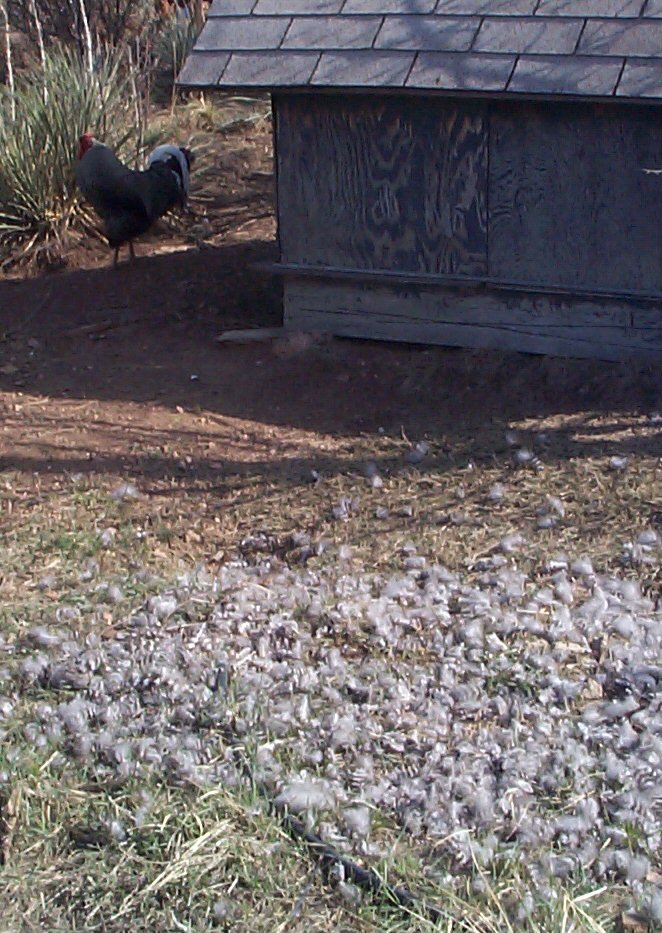
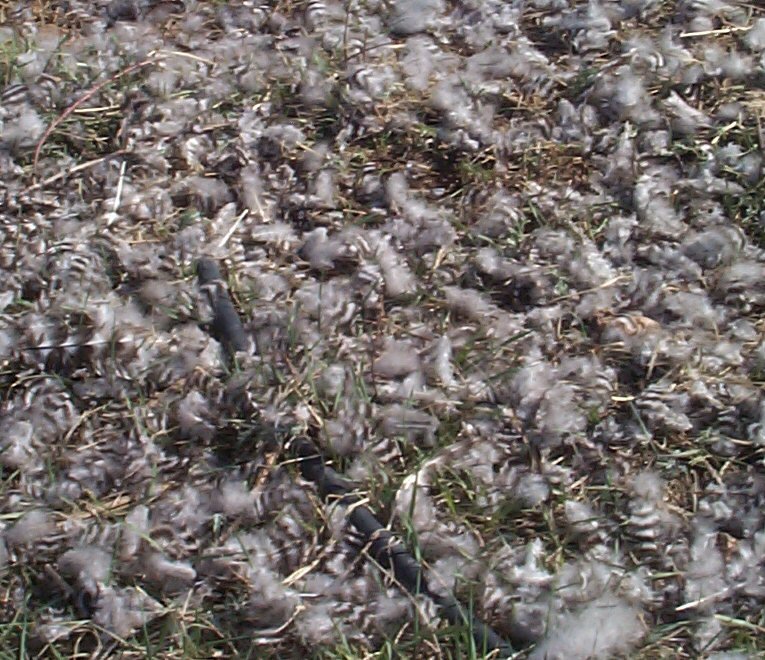
Barred rocks are one of our favorite breeds. The hens are sweet, friendly, productive, and hardy—you can’t ask for more. This is what a barred rock looks like after an eagle is done with her. (Note there’s a live barred-rock rooster in the background.) Very tidy: no body, not even a speck of blood.

This neat circle of feathers is, by the way, a prime way to tell a bird kill from a carcass killed by a mammal, as the latter usually don’t bother to pluck their prey. If they do, they pull the feathers out in mouthfuls, so you generally find clumps stuck together by saliva. Given time by my absence, the eagle carefully plucked each kill, presumably ate at leisure, and carried off the remains of the meal. Back to the babies.

The difficult times are when you hear the alarm and, roused by continued squawking, run outside to see what’s the matter. That, of course, spooks the eagle, who promptly takes off. You’re left with a dying bird, and the eagle still has to find lunch elsewhere. That’s a no-win situation. Much cleaner if you can muster the restraint to stay inside until it’s all over.