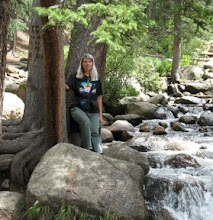
Lately reviewing material I wrote back in 1988-1993, when I was walking up Mt Falcon on a regular basis, I've been reminded of the naturalist’s perspective. In 2006, I found myself engaged in an extended attempt to reach consensus among diverse users of a local open space: hikers, bikers, trail runners, geologists, equestrians, and those I can only call naturalists, for lack of anything more definitive. In an effort to explain what the latter were about when they went about, I came up with the following:
First, naturalists are not hikers. They may appear to be hiking, because their feet are their mode of transportation. Hikers, however, are going somewhere. Naturalists, most often, are already there as soon as they set foot on the trail. Here’s an example. I led a Native Plant Society field trip at Mt Falcon one summer. I think we got about 200 yards in the first two hours. Maybe.
Naturalists look at things (that’s why they’re usually so slow). Hikers, bikers, others may look at scenery, I’m willing to admit that, but naturalists LOOK, really look, at things. (And touch them and smell them and whatever else.) They may, depending on their type, be looking at or for birds, butterflies, insects, flowers, trees, ferns, spiders, grasses, shrubs, lichens, geology, rocks, fossils, water, patterns, snakes, salamanders, frogs, fish, fungi, bugs, big critters, little critters, or scat, to name a few --but they are most likely looking AT something. They may be looking at or for a specific KIND of something, like carrion beetles, zeolites, sulfurs, oak galls, rock tripes, or moonworts. They may even be looking at or for all of the above.
Naturalists have expectations. If they observe a certain plant or animal or rock at a location in May, they will expect to see it again in September. If they observe it in 1994, they will know exactly where to look for it when they come to the spot again in 2004.
Worst of all, naturalists are unpredictable (though they expect Nature not to be). They are prone to sudden right-angle changes of direction whenever their eyes or ears or noses catch something. They are likely to stop dead right in front of you or walk to the edge of the path or drop to hands and knees without warning. They are alert, but not to other trail users. They may be lost in another world, and probably don’t even hear people coming because their senses are tuned to different stimuli. They're dangerous.
Lastly, I can believe that naturalists could travel on horseback. I can’t believe you can experience the naturalist’s perspective from a mountain bike, though I accept that bikers enjoy the outdoors, the aspens, the historic discoveries, etc, in their own ways. First there’s the speed, which severely limits bikers' ability to see the minutiae naturalists are so fond of. Second, the constant off/on, mounting/dismounting if you DID see something would take the fun out of the ride. Third, there seem to be social and physiological benefits to biking that naturalists rarely experience, traveling alone or in small units, and rarely if ever getting to aerobic levels. Let’s call it a different kind of fitness.
Thus, naturalists are just different. Not right or wrong, just different. All part of that human diversity we cherish. The thing is, they need open spaces, especially relatively untrammeled open spaces, for their chosen “sport.” Tamed urban spaces just don’t cut it the way remnants of the wild, however modified, still can.
In hopes of engaging a conversation about this idea, and the fate of naturalists in today's world, I set up a separate blog. Meet me there if you'd like to help create a conversation on what we do and why we do it.