Showing posts with label geology. Show all posts

Saturday, December 25, 2010

Watching the Watcher

Over at Watching the World Wake Up, the Watcher recently completed a marvelous four-part Thanksgiving chronicle that dredges up all kinds of memories of the more adventurous days of my own youth. He covers dinosaur tracks, muddy roads, rock art, geology, and of course desert botany in this quadruple tour-de-force. I'm in awe of his blogging talent, so, yes, I'm a Watcher Watcher.

Watcher's contributions to the blog world include the invention of the tangent and the nested tangent, without which his posts would be eversomuch more straightforward and possibly even dull. Some visitors flock to his site just for the tangents! And, of course, the allusions to Selma Hayek.

And his posts are LONG! Settle in, it's going to be a substantial visit, but you will come away having learned some remarkable tidbit of esoteric knowledge you would never have thought to look up for yourself. On average (n=1), his posts are 12,500 pixels long, or 2,300 words (n=2). I thought that chicken post below was long; it comes in at less than half the length of a typical Watcher post.

Nor does the Watcher neglect illustration. If he fails (on the rare occasion it's been known to happen) to capture a photograph, he will create an Awesome Graphic, an art form he invented (along with the subcategories Expand-o-graphic and Action Graphic). Some complex concepts, of course, demand an Awesome Graphic and could not be otherwise illustrated. [This one is from his post on seeing the Mexican flag come to life.]

I don't know how he does it all, but I'm glad he does!!

He can't stop, apparently, with knowing that birds have pentachromatic vision, or that some, but not all, Springbeauties are tetraploid. Instead he takes his readers into the nitty gritty of what that means, plumbing the depths of whatever science (astronomy, psychology, physiology, genetics, geology, archaeology, zoology, botany) presents itself. It's like he has a post for everything!

Want to know How Magpies build their nests or All about Greek Mythology? There's a post for that!

One aspect of the Watcher's work, however, fills me with dismay. He thinks of his blog as a "project" that will, one day, be "completed." On that day, the blog world will be an emptier place.

———

Off Topic: The little sponges we are as children just soak up all kinds of stuff, and just thinking of writing this post brought back memories of the Watchbird. For those whose childhood was more deprived, here's a bit about the Watchbird:

In the baby boom years, I suppose parents needed all the help they could get rearing responsible offspring of good character. Some of that "help" came from the Watchbird, a cartoon created by Munro Leaf to remind us how to behave. Apparently some of my peers have more sinister recollections of the Watchbird, but I (of course) was trying to be good, and the Watchbird regularly showed us examples of bad children: the Whinie, the Sneaky, the Pusher... (honestly, I've forgotten all of them!) I guess you could say it was negative reinforcement, and maybe that's why it's frowned upon today. Like spankings and other forms of archaic parental guidance, however, it was effective! Contrariwise, as Hootsbuddy recalls:
Maybe it was this early training that made part of me into a Watchbird. I dunno. In any case, it missed the mark. I was suppose to identify with someone in the cartoon, not the Watchbird. I guess even at that early age I was more prone to judging than being judged.

(As long as I'm being quantitative, I should mention that Hootsbuddy's Place (which I found on a "Watchbird" search) looks pretty interesting. He managed to rack up more than 3,000 posts featuring all kinds of commentary in less than six years... and then stopped abruptly in mid-2009, as we all probably will someday.)

My Visit to the Book Cliffs
At any rate, the Watcher's posts quite often strike a chord. This last one especially brought back days of trucking around the Book Cliffs on (gulp) synfuels reconnaissance. (Ah, the last big boom; those were the days, eh?) I remember two special events. [Pic right, not mine.]

Watcher reports: "Once you get off the asphalt, Mancos is both wonderful and horrible. In dry conditions, graded dirt roads across the Mancos are often smooth and fast, allowing a passenger car to zip comfortably along at 40 or 50 MPH. But when wet, forget it." (Whence he goes on to explain, in true Watcher-style, about smectitic clays.)

I can't say I remember that it was Mancos Shale we were driving on, but I do remember "smooth and fast." As you approach the Book Cliffs (which in my day were apparently closer to I-70 than they are now), you start winding around the toes of the cliffs. Cruising around one such hairpin, a bit too fast probably, I found myself face to face with a huge logging truck (he was probably also moving right along). We both slammed on the brakes, and came to a mutual stop with our side mirrors almost touching. Whew! Survived that one...

While in the Cliffs, we had a good time cruising across washes, which of course are more fun if they have water in them. If you went fast enough (it was a rental vehicle, and I was, after all, young), you could get a good splash going!

Anyway, when we left to return to Grand Junction, it was beginning to snow a bit. In fact, it quickly became a whiteout, though I don't remember that there was much accumulation. As we drove south toward I-70, confident it was out there somewhere, a helicopter landed next to the road to ask us for directions!! In the decades since, I can't say that's ever happened again!

So, Watcher, as always "Thanks for the memories!"


Saturday, September 04, 2010

Adventures in Geo-Browsing

You never know where the current edition of Berry-Go-Round (now hosted by Laurent at Seeds Aside) will take you!

After browsing several of the fascinating offerings, my love of lichens took me to Botany for Geologists where David at History of Geology does a great job of explaining lichenometry, or the use of lichens to date exposed rock surfaces.

In his sidebar, I discovered Eat.Sleep.Geology., by a neogeoblogger whose nom de plume is GeoGirl. She soon led me to the geologists' blog carnival over at The Accretionary Wedge, which provided great ideas for future Berries as well as a long list of future reading.

Geology class at a local outcrop.


David also tipped me off to Riparian Rap, whose series on geomorphically incorrect art is mind-bending entertainment.

As always in the blog world, you can make your way around the planet and back again in a few clicks, and learn a lot about how it's put together in the process.


Thursday, August 27, 2009

Dune


Recall saltation:
Sand grains dancing on the wind
Can create mountains.

Under a restless wind
They jump, twist, and shudder on,
Overtaking pines.


It was my first visit to Great Sand Dunes; it’s funny how a word you haven’t used in polite conversation in decades (or ever?) effortlessly pops back into your vocabulary. As did “barchan” and “parabolic,” though the Park Naturalists didn’t seem to know what I was asking about.

How tiny the people are.
August 8, 2009

Wednesday, November 12, 2008

Quarry

Q is for Quarry, and the Quest therefor. This place where Earth's bones were torn from their long home almost a century and a half ago, yet the rock has still not healed. Exposed sandstone reveals the spot; occasional marks of the tools used so long ago. A steep climb, tough to imagine men working here in those early days.

Nearby, the rocks are cloaked with lichens, proof of their undisturbance. They watched as George Morrison "settled" this place, using its native rock to grow buildings. Some remain today; some do not.

But the view goes on.

More Qs at ABC Wednesday; we are joining mid-alphabet.

Saturday, February 09, 2008

Winter Escapes

The sun is bright and it’s warming through the 40s F (single digits C) already, but the north yard is locked in snow and it’s clearly still winter. My neighbors are off to the sunny beaches of Cabo San Lucas today, and that puts me in mind of our local beaches.

Even I’d agree that there’s nothing like stretching out in the warm sand on a winter or just-barely-spring day. You might think beaches are rare in Colorado, but that’s only the case if you take the modern view. For those of us who live in the past—the really distant past—sandy beaches abound.

To find them, you just have to ask a geologist instead of a surfer. Far more of the former than the latter in Colorado anyway, I suspect.

The sand of these Dakota beaches does not welcome or warm the toes, and probably isn't quite as comfortable to lie on. No sand castles will be built here: this beach was loose sand about 100 million years ago. Not only is this beach too far from the sea now, and some 6,000 ft vertical (more than 1,800 m), but it hasn't been horizontal for more than 65 million years.

Let's take a few steps back, get the trees vertical, and look at it again. The Dakota Sandstone may have provided beaches where Cretaceous dinosaurs chased each other, as evidenced locally by fossilized footprints, but it'd be a challenge to run along it these days.

More pictures of the Dakota hogback at the January 23 post. Dinosaur footprint picture at Dinosaur Ridge.

——
This spring hike was previously reported at Eldorado Gold.

Wednesday, January 23, 2008

Time and Place

Instead of a view from home this morning, we'll take a look at a wider view of the home territory of Foothills Fancies as we know it today. This aerial photo clearly displays the captivating ecotone between the plains (down and right) and the higher mountains to the west—the zone we know as foothills.

Morrison area, about 1990
"Home," in the immediate personal sense, is just out of the picture on the left edge, enabling an excellent view north up the valley into the dramatic sculptures of red sandstone. What intrigues me today is that I fell in love with this view, this area, long before I ever saw it. Growing up in New York State, I couldn't even imagine such landscapes. The photo below, in a college textbook many years ago, introduced me to the concept of a hogback, the striking feature that dominates this photo and now defines my home range.

Morrison area, about 1932Photo by T.S. Lovering, 1932, courtesy USGS.

This geological paradise is hemmed in by the 1.7-billion-year-old rocks of Mt. Morrison on the left and the Dakota Hogback, which defines the eastern edge of the foothills and almost seems to confine the denser forms of human civilization to the plains beyond it. A virtual border we cross regularly, it marks a change in perspective from urban to mountain, from human-dominated landscapes to those where Nature, and especially geology, are factors that can't be entirely forgotten.

These photos, taken more than 50 years apart, also express change. In the earlier image, we see almost nothing artificial. A stretch of the Turkey Creek road on the west (left), a quarry lake on the right, but little else of human creation is visible, despite more than 70 years of "civilized" occupation of this landscape. Another half-century brings a few differences we can see at the scale of these photos. Houses and trees now obscure the road to Turkey Creek. The Dakota Hogback remains, but its base is scarred by a local speedway and a new road traverses it. But the delicate fin of limestone that lay east of it has been obliterated by a superhighway. Still, this landscape is largely protected compared with others in the Front Range. Much of the area of this photo is parkland and open space, preserved for its beauty and for use for recreation.

My very first geology professor taught us that geology is everything. He got our attention; to him even the Civil War was a matter of geology. The Industrial Revolution? Fueled by geology. The unique characters of New York, Pittsburgh, Chicago, San Francisco, New Orleans are shaped by their geology. Civilizations rising or falling, wars won or lost, all were geology, if you looked deeply enough. Geology is, according to ecologist Paul Sears, "the Great Eye-Opener" we need to understand the landscapes we live in and how they shape us. In short, Geology Rocks!

Wednesday, January 24, 2007

Odds are...

that most of us believe in numbers. But we rarely live our lives by them. If we did, we probably wouldn't drive! Yesterday, I had what was, for me, an unprecedented experience that reminded me of the assumptions we make daily about events we rarely witness. I decided to drive to Kittredge, a small settlement 7 miles up Bear Creek Canyon.

But a trip to Kittredge isn't unusual. Something happened to shake, just a bit, my confidence in the odds. Our most recent snow, on Sunday, had brought another 6 to 8 inches to add to our growing piles. But yesterday, Monday even, everything started to melt. The piles are gradually slumping and, if warm temperatures prevail, will dwindle.

What does that mean for a drive in the canyon?

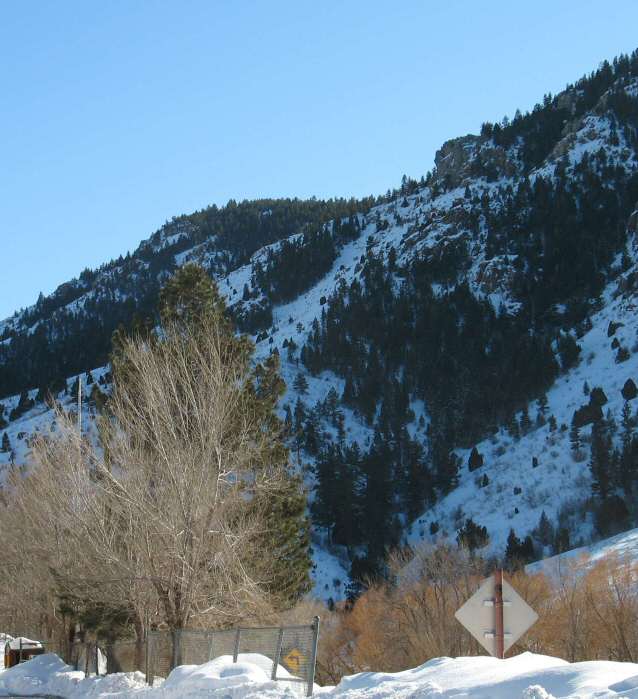
Bear Creek runs roughly west to east, with lots of twists and turns. At the mouth of the Bear, the canyon is especially steep and narrow. Its north-facing slopes (photo) remained bound in snow, but its south-facing rock walls were warm and dripping, as snow and ice were hit by the sun for just a few hours of the day. In fact, returning just an hour later, at 2:30 p.m., those warm walls were already feeling the lengthening chill of premature sunset.

Above, my peripheral vision caught a falling object, a rock loosened by the thawing of its resident cliff face. It landed in the road ahead of me. There wasn't even time to swerve, only to register that it was flat enough to drive over. Apparently, my number was not yet up!

After that, rather more alert, I began to notice the number of new rocks on and along the road. It crossed my mind it might not be the best day for a canyon drive, with temps in the 40s after a cold night. I went on, reminding myself that hundreds, maybe thousands, drive this canyon daily without mishap. Is there really strength, or just reassurance, in numbers?

Witnessing geology in action gives you pause. Sure, the road is lined with "Falling Rocks" signs, but how many of us notice them? And what are you supposed to do with that warning? Falling rocks are not rare, just unpredictable. Yesterday, geology was acting mostly on smallish rocks, less than a foot in diameter, but surely geology has proven capable of much more, even recently right here on the Front Range.

Somehow, it's comforting to know that you'll never see the one that hits you!