Thursday, April 23, 2009

Elk in Velvet--and a Surprise

Our Earth Day hike (see following post, actually written first) brought us a few other delights of discovery, mostly on the return trip. Stomping through one of the wet snow patches, I noticed some tracks that didn't belong to us or the dog. Puzzled, intrigued, and grateful we hadn't obliterated them on the way out, we searched for some clear enough to photograph. Here they are, once again without a scale object other than a few Doug-fir needles, but they would have looked nice with one of my Colorado quarters I keep forgetting to bring.

The tracks were too big for the squirrels we had been discussing, too small for a dog and not-quite-right for raccoon, we thought, though there was some resemblance. In the snow, they looked almost like an infant's handprint, except for distinct claw marks. Bee Lady decided on a Pine Marten, and I quite liked that conclusion. It could, of course, been some other small weasel, but we relished the thought of this little guy watching us from a tree while we looked for him.

The Pine Marten or American Marten (Martes americana) is the largest weasel we're likely to see in these parts, Fishers being pretty rare, and Wolverines almost nonexistent. Apparently secure in Colorado and several other western states, the Marten is imperiled or vulnerable in Utah, New Mexico, Nevada, California, and Oregon, as well as in most of the northeast. Its broad range, though, makes it globally secure thanks to abundant populations in Canada. (See Distribution map at NatureServe.org.)

Check out the photo—pretty cute, huh? (U.S. Fish & Wildlife Service.) I shouldn't feel too bad about never having seen one—my source says "even people who live in marten habitat may seldom see them." Darling Husband did see one on a hike in the mountains a few years ago. Ours was probably watching from the treetops as we headed back down the trail.

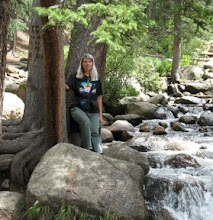
Here are the photos DH took, June 2007, near the trailhead to Gray's and Torrey's Peaks. Brightening to get his face to show up washed out the old snow behind him; not as perfect a pose as the one above. Click to get a better view of him.

Also a rear view, in typical weasel observation pose, to show off his shape. These guys are about the size of a small housecat.

We'd somehow overlooked a couple signs of spring on the way out. First, I spotted this Mountain Candytuft (Thlaspi alpestre), a delicate spring mustard that is easy to miss, usually occurring by itself, scattered along the trail. We saw only this one.

Next up was the one we'd been looking for: the Mountain Ball Cactus (Pediocactus simpsonii). It's a dramatic plant, especially when in flower, but very capable of hiding in plain sight among the rocks and lichens. Often where there's one of these beauties, there will be more, but again, we saw only one blooming.

Still with me? If so, you're probably wondering about those Elk by now. We found them again, in a meadow a little further downstream, and took a quick detour for a better look. Five or six, mostly bulls (maybe all bulls, some just too young to show antlers), in the picnic area along the trail.

They are just beginning to regrow their annual racks, now just fuzzy protrusions from their foreheads as they grazed. Again, without scale, it's hard to convey how BIG these guys are! Almost 5 feet (1.5 m) at the shoulder, and weighing in the neighborhood of 700 pounds (320 kg), they are twice as heavy as Mule Deer (though they easily look three times!). Somehow, though they're around daily in the mountains west of home, it's still always exciting to see them (at least for those of us who don't have them munching on our landscaping).

So, in all, a great day on our little part of the Earth!

A Little More on Elk


By the final years of the 19th century, when the frontier was not only closed but almost sterilized, Elk had become so rare from overhunting that their conservation became an important effort in the early 1900s. When the bison preserve at Genesee Park was established in 1914 (with bison imported from Yellowstone Park), a couple dozen Elk were brought along to form the nucleus of the herd that still resides there.

The irony is that, 95 years later, the captive herd is well outnumbered by wild Elk (like the ones pictured above) in the foothills west of Denver. Today the species is not only back from the brink of extinction, but so numerous that it is one of the Rockies' most popular game animals with hunters. Elk have even overpopulated habitat in Rocky Mountain National Park to the extent that culling has again become necessary there. An Elk Vegetation Management Plan guided removal that started in February and took about 33 elk (out of 100 planned), all cows. A bit of fertility control is also being tried out on the remaining herd. The program has been controversial, as the following articles show.

Elk culling to begin
First animals taken
Wolves are the better answer
Estes Park residents disagree on culling plan

Wednesday, April 22, 2009

It's Earth Day!

Finally, Earth Day and Spring seem to be arriving simultaneously! Thirty-nine years later, it seems we don't hear enough about Earth Day, which should certainly be (along with Buy-Nothing Day, the Friday after Thanksgiving) our most significant—and transformative—holiday.

I still remember that first Earth Day, when we thought picking up garbage was a significant way to celebrate. The world, or at least this state-side portion of it, has indeed been transformed since then, so subtly we often fail to realize it. Although it seems we can never do enough, let's look at a few things that have changed for the better since 1970, signs of the times, at how full our collective glass really is.

Litter: once ubiquitous on major highways; drivers were warned of the consequences of throwing refuse out car windows. $500 fines, rarely enforceable, have been replaced by Adopt-a-Highway signs, and volunteers help keep our scenery looking more scenic and less trashed than in 1970.

Endangered species: yes, and more of them than ever, but the Bald Eagle, our national symbol, is no longer among them. Neither is the Peregrine Falcon, the American Alligator, the Gray Wolf, or the Grizzly Bear. Whooping Cranes, Desert Pupfish, California Condors, and Black-footed Ferrets have not disappeared as predicted, thanks to strenuous measures by many people. Your children don't even remember DDT or the spray trucks of summer, implicated in many of those declines.

However, 51 species have been delisted, and not all of them are charismatic megafauna. Delisting always makes me nervous; guess I'm naturally suspicious. Here's the scoop, in case you were wondering. Of those 51 species, 25 have been delisted because of recovery. Seventeen have been delisted because the "original data [were] in error." Unfortunately, the remaining nine have been delisted by reason of the fact that they've gone extinct. How many of us can name even one of them? (See Requiem, below.)

Habitat protection: although still committed to resource extraction, most land-management agencies at least acknowledge and evaluate the consequences of their actions. We have, thanks to many nongovernmental organizations as well, more protected habitat nationwide than we did in 1970, and we can't have wildlife and wild plant diversity without habitat.

Air and water quality: places where city sewage flows freely into local streams and industries spew poisons into the air unregulated are no longer a daily experience in most communities.

For all that remains to be done, we are fortunate here in the U.S. that significant progress has been made. But it is not cause to rest. For each item in the list, there is bad news somewhere, and we don't need to look far to find it.

——
Requiem (with date delisted): Guam Broadbill (2/24/04); Longjaw Cisco (9/2/83); Amistad Gambusia (12/4/87); Mariana Mallard (2/23/04); Sampson's Pearlymussel (1/9/84); Blue Pike (9/2/83); Tecopa Pupfish (1/15/82); Santa Barbara Song Sparrow (10/12/83); Dusky Seaside Sparrow (12/12/90).

Tuesday, April 21, 2009

The Birds of April

Once again, I'm launching a new feature here at FF. Given my track record, I just know I shouldn't say that!

This time, it's a monthly compilation of visiting and resident birds. This is that transitional shoulder-season, when winter friends will disappear without a fare-thee-well, and returning guests show up to delight and amuse us. Any day now, the Hummingbirds. We must be prepared!

We have some newcomers this month, some "never befores" to report, like the one in this photo. And I'd never thought to take the camera to the mailbox with me, but would that I had today! I'll probably never see again this never-before bird, nor ever be sure of its identity.

April is not over, that we know. But here's the list so far... let's expect a few more before the month is out! Most were at the feeders; a few obvious ones (Vultures and Eagles, for example) were not. Never-befores (only one this month) are in blue.

That's 27 total, and the migrants haven't even arrived yet! Links go to those whose photos have been previously posted.

The White-breasted Nuthatch was unexpected, not having popped in before. (She's acrobatic, but not as much as Blogger would have you believe. Gravity still prevails, even here. If anyone can tell me why Blogger occasionally does this or how to overcome it, I'd be grateful.) She has become a regular, at least for now, checking the suet feeder periodically over the past week. That distinguishes from her cousin, the Red-breasted Nuthatch, who showed up just once back in May 2008.

As with other suet-lovers, these Nuthatches are insectivores and cavity-nesters. Their young are almost totally dependent on animal foods. They also, according to Erhlich et al., sometimes join mixed-species flocks, which can confer feeding advantages as well as protection from predators.

There are a few more I'd like to mention, seen or heard in the immediate area (that is, the area seen in the "views from home" photos). These are the Canyon Wren I heard among the cliffs of Red Rocks yesterday, one of the few bird songs I recognize. (We're working on that; more to report soon.) And last night, wonder of wonders, a new sound in the dark. Husband, then Friends, had reported this, but last night, I heard it, all by myself. Outside in the dark, a sound like a cross between a coyote and a goose... barking overhead, the migrating Sandhill Cranes!

And the mailbox bird? Something gallinaceous. The best I can come up with is Sharp-tailed Grouse, two of them, just meandering along the road. Gone, of course, by the time I returned with binocs and camera.

A joyous Spring, indeed! (I'd better go buy suet!)

——
Erhlich, Paul R., David S. Dobkin, and Darryl Wheye. 1988. The Birder's Handbook: A Field Guide to the Natural History of North American Birds. Simon & Schuster. 785 p. (an encyclopedic complement to your identification guides)

The Road to Hell

I have so much to blog about! Watcher-like, I'd even made a plan, a list of things to cover here at Foothills Fancies. And yet, that prickly pear cordial sat up here all month, embarrassing me by its continued top-o'-the-blog presence when there are spring storms to cover (another foot of white stuff last Friday that I missed almost completely), an entire round-trip across Colorado, Earth Day tomorrow and my wistful plan to cover Good Earth stuff all month... sigh. Time has not been on my side of late.

And now, thanks to a snowy April putting us back on track for annual moisture (and then some!), green and growing things will be bursting out of the ground faster than I can record them. Hallelujah, it's April, and spring is really here this time! (I'm convinced, anyway, what with it hitting almost 80 today, 27C.)

Coming Attractions: Well, we've got Flicker Love, The Bird List (yes, I've finally started keeping track, sort of), Trophy Hunting, geological discoveries, the Windshield Survey of Colorado (with a little bit of Utah thrown in), and more, much more.

Expect wonders! What else can I say on a fine spring day?

Sunday, April 05, 2009

Fruits of No Labor

Well, almost none (on my part anyway). The Collector put out a plea last fall for someone to take a bucket of fruit off her hands, and I was among the lucky recipients. It took a while to get around to "processing" my bounty; she said the first step was to be sure to use dishwashing gloves to wash the fruit, so first I had to acquire a pair of those. One evening in November, gloves on hands, I undertook the process—first washing and cutting up the glorious purple prickly pears, or tuna, as they are known in the southwest.

FF is not, as I trust you know, a recipe blog, but we're going to make a single exception here, and I hope you'll forgive the digression. Consider it an aberration induced by this unseasonably snowy weather.

Here they are, all washed, on the cutting board. The Collector assured me most of the glochids would sink to the bottom of the wash bowl as I gently rubbed the fruit in the water, but handling without gloves was still not advisable. I decided, to allow maximum flavor development, to cut each fruit in half. This also provides a small opportunity for an anatomy lesson.

The fruit reflects the flower, of course, and cactus flowers are classic examples of hypogyny. Hypo (below) and gyn (female or ovary) tells us the ovary is below the flower we notice, that is, the showy petals and sepals (tepals) are attached above the ovary. The seeds and fruit will develop below the withered remains of the flower, rather than above, as they do in the tulip. In this photo, the white spot represents the flower base, where it attaches to the main plant. At the other end of the fruit is a tough brown bowl shape that once held the tepals and stamens on its rim. In between is the ovary, full of seeds and surrounded by a thin red-purple layer of fleshy fruit. A few of the mucilaginous seeds are artfully scattered nearby, along with a cluster of spines.

Thankfully, the spines are on the pads of the plant, not the fruits. This one just came along for the ride, adding a little thrill of danger to the processing.

Perhaps this is a good place to point out that not all cactus, nor all prickly pear species, make nice juicy fruits like these. Some, like our cholla, have dried up non-fleshy fruits that are not much use for things like jelly, syrup, or (in the case of our recipe here) cordial. These tuna are from Opuntia phaeacantha, a large-padded prickly pear native to the Four Corners states (AZ, UT, CO, NM) and those bordering them east and west, as well as, for some reason, South Dakota. The species name suggests the abundant and obvious grey or dusky (phae-) spines on this common desert plant. The large pads are often bluish in color; the flowers are more often yellow-orange, only occasionally magenta. [Photo courtesy of and copyrighted by Al Schneider, of Colorado Wildflowers, a great site, by the way; he is also the Colorado Native Plant Society webmaster.] Here's the range map too, from the USDA Plants database, who for some reason call this plant "Tulip Prickly Pear." Better known, perhaps, as Mojave, plains, or desert prickly pear. See also Al's page on this species.


Methods: On to our recipe, or more accurately formula. So easy even I can do it, but the attempt was, for this fruit at least, experimental. Take a jar, any size, and fill it two-thirds full of fruit, topped with one-third sugar cubes. Keep the proportions correct by volume, even if the jar is not full, as here. You must use cubes to assure the volume; granulated sugar would just fall down and fill the spaces between the fruit, resulting in an improper measurement. (As you can see, accuracy is critical, so just eyeball it.)

Then fill to the top of the sugar cubes with an alcohol base of your choice, usually vodka (unflavored, please) or whisky (a cheap one is fine; this is not the place for your best stuff).

Anthocyanins being what they are, these red and purple pigments diffused into the whisky almost instantly, making a wonderfully cheery solution as the sugar slowly dissolved and settled to the bottom. (Don't add more, your proportions are already set.)

By morning, the sugar disappeared and the fruit had floated to the top. At this point, if your jar isn't full, it would be wise to weight the fruit to ensure it stays below the surface and avoid the possibility of mold. I used crumpled wax paper to fill the extra space and push the fruit down a bit. Cover the jar, but not too tightly.

Now comes the hard part: waiting. Several months. Put the jar in a cool dark place (this shot was specially posed, I couldn't resist the shaft of sunlight on the fruit!)... and wait. Time passes faster if you hide the jar away and try to forget it's there.

Then, some day months later, you can decant your concoction and see how you did! I usually filter through coffee filters (muslin or some such would work too), and in this case, that was a challenge! The brew was slower than usual; it took a couple days to persuade a pint or so through. I really didn't want to be sipping glochids, though. When I mentioned the problem to the Collector, she enlightened me: that mucilage around the seeds gives a dense consistency to any juice from this fruit.

Results: The experiment has been deemed a success by several testers. I thought it was a bit of an acquired taste, this prickly pear cordial, but that may have been because of the complex undertones added by the whisky. Next time, I think I'll try it with vodka instead. Vodka might also better preserve the intense red color, which seems to be lost a bit with the whisky base.

In any event, some snowy Sunday in April, this concoction will deliver a burst of fall flavor more than adequate to toast the past harvest and urge a reluctant spring forward.

Cheers!

Saturday, April 04, 2009

A Little Excitement for a Snowy Day


Just when we thought the long quiet day was winding down to a quiet end, we heard the telltale thump of a bird hitting the window. I looked out in time to see this visitor swoop onto the pole holding the bird feeder. Big! Too big to be our old friend Artemis. Darling Husband double-checked the book, and sure 'nuff—Cooper's Hawk.

From the post, the bird hopped into the nearby ash tree to sit and pose for this photo by DH. (Because of her size, we're going with "she" this time.) Moments later, she dropped to the ground near some bushes, then hopped up onto a branch near the fence.

We couldn't quite make out what was struggling in her grip as she ripped feathers from some small body. She'd picked a perch obscured by the gate and two layers of fencing. The plucking seemed to take awhile; but once prepared, the meal disappeared quickly.

No longer hungry, she looked merely bored as she rested and contemplated her next move. In her own sweet time, she lightened her load, looked around a bit more, then launched off through the trees. Only a spot of blood on the branch, one fresh dropping below, and a scattering of junco feathers on the snow told the story.

The survivors promptly returned to the feeder.

Status Quo

Spring, at least a spring where we can talk about plants and flowers doing interesting things, has been indefinitely delayed. At last report, we are apparently due for snowy cold days every few days for the rest of the week. For an idea of what's going on out there today, please see the previous post. Same scene, next verse. Birds, suet, drab gray... on it goes.

Happily, we can get our plant fix elsewhere this week, with the current Berry-Go-Round carnival, now posted at Neotropical Savanna. A taste of the tropics, a little evolution, some springy thingies, tips on orchid gender, and a peek at neato-phytes all await your exploration over there in Panama, where it's much more plant-friendly than here.

The Propagator and I got into a lively discussion last night at First Friday: he brought along a single bloom plucked from one his Aporophyllum plants, which are apparently blooming like crazy! So a field trip to his greenhouse may be in order this week... we've got to find something botanical to report, and I need a dose of spring! (I'm not complaining, mind—until this week, we hadn't had snow all year, and I shan't look askance at gift moisture!)

Monday, March 30, 2009

Old Man Winter

is back... This time only a couple of inches, they say. Timely, as last Thursday's 12 inches were pretty much gone by last night. The chicken door, connected to the house by a Rube-Goldbergian contraption that allows remote opening, is not responding, necessitating a trip all the way out to the coop to free them. (Though it's not likely they'll come out much til this clears up.)

Was it just last week I was wondering whether the Juncos had left for good? Not so, they are still here in force and in just about every flavor: one dark-headed Oregon among the pink-sided and gray-headed. One of the latter even has white wing-tips; have been seeing him all winter. Joining them today are a few House Finches and several Pine Siskins. The Towhee is scratching madly under the rabbitbrush... The Downy Woodpecker came by yesterday for a taste of suet; and of course, always the Starlings, Scrub Jays, Magpies. Have not seen a Chickadee lately...

Is it really Old Man Winter, or is this the true face of graceful, feminine Spring? For another take on the seasonal gender, check out the Watcher, who persuasively argues for a female season here in the West.

Either way, yesterday I traveled to catch one more glimpse of the remains of last week's storm. Echo Lake was frozen, not surprising at 10,600 ft (3,231 m). Mt. Evans' vertical surfaces shed the snow, and much of the distant tundra had been swept clear, not quite the white-draped view I'd expected.

Sunday, March 29, 2009

Going Dark...

Say what, Dave? After reminding all of us ten days ago, and even giving us a link so we could look it up again, you forgot?? As one commenter noted: "You missed the opportunity to make a token and ultimately futile gesture and possibly unbalance our antiquated power grid, just to watch a basketball game?"

That's right—last night was Earth Hour 2009, in which the whole world turns off its lights for an hour to give Gaia a little breathing space. What, you didn't hear about it? Neither did I, til I read about it on Dave's blog... and neither, it seems, did anyone in our neighborhood or visible area. I'm getting the distinct impression that this token and ultimately futile gesture has not breached the bastions of American unconformity. Can it be that the last eight years of propaganda have cost us our perspective, our sense of being part of a global problem and its solution?

After catching the drift last week at Osage, I managed to forget again too! Until it was too late to remind others and barely time to observe this auspicious occasion ourselves. Off went the TV and, yes, even the computer!, on went a few candles. What do we do, non-electronically, with an hour of quiet and dark? We've forgotten how to behave! Some obligatory chit-chat about the fate of the world, coming fast and furiously it seems... about our personal awareness and commitment and the inadequacy thereof and new measures we should be adopting. And reminders of a simpler time, when it seemed there might be answers to the world's most troubling questions: listening to a few rounds of old folkies (some dead) on... vinyl! The archaic turntable, though powered by the grid, seemed more appropriate than the flickering blue box, oh so addictive.

By the time we groped close to the clock with a candle, the hour was more than spent—we'd actually overshot the goal! And had a pleasant evening together to boot... something we should put on the agenda every week. This is an event we can celebrate anytime—it would do us all good to be reminded, I suspect, and... good practice for the future!

So, thanks, Dave, for making sure we didn't miss out this year!

(By the way, there's a great cartoon over at Tree Lobsters.)

Thursday, March 26, 2009

Waiting for Winter

This time the weatherpeople sound serious. A couple of feet of white stuff by the weekend—the most promising outlook for moisture we've had all winter!1 It was difficult to believe them, though, with temps hovering in the 60s, buds and flowers a'popping, meadowlarks back in town. Still, the clouds yesterday, the small scent of moisture in the air, and a light dusting this a.m. gave hope that, for once, they'd be right.

The whole picture is changing as the morning advances, and it's not even 9 a.m. yet. At last. The flakes are getting bigger, the day's scheduled events are being canceled... I'm glad I filled the birdfeeders last night, and am even having trouble working up enthusiasm for schlepping out to the chickens! But that chore must be done, whether all else is postponed or no.

At this point in the season, I'd have been happier with the liquid rather than crystalline version of H2O, and I think the plants might have as well...but it's been SO dry, all of us will take any form we can get, and gladly! Bee Lady went out to check on the Mountain Ball Cactus, and reported they were trying to bloom, but the few plants she found were barely succeeding in putting forth a few pale flowers.

Would that I had a few seeds in the ground under this, but I'm not that good a gardener. I did manage to plant some of the cholla I salvaged, but that was all that seemed appropriate for what was shaping up to be one of our drier years (until today). Here's a preview of my new cactus garden; this weather should be good for them!

In all, a good day to stay home and reread The Phantom Tollbooth!2

"Oh no," said the little man, "I'm the Whether Man, not the Weather Man, for after all, it's more important to know whether there will be weather than what the weather will be." And with that, he released a dozen balloons that sailed off into the sky. "Must see which way the wind is blowing," he said...

—Norton Juster, from The Phantom Tollbooth


——
1 Now that it's spring, of course. For a description of Colorado springtime, see Spring Sap Rising.
2 Highest recommendation... in fact I should have listed it on the book post! Time to get reacquainted with Milo, Tock the Watch Dog, the Humbug, Officer Shrift (shortest policeman you'll ever meet), Faintly Macabre the Not-so-Wicked Witch, and all the other wonderful characters out there Beyond Expectations.

Monday, March 09, 2009

Tree Cholla: Plant of the Week

If you're one of those people who rescues stray kittens, perhaps you'll understand the impulse that led me to bring home this bucket o'cholla last week. A new neighbor had apparently been inconvenienced (or perhaps attacked) by these plants outside his front door, and chopped them all down. Then he threw them across the street on untamed property. (Okay, a gulch in a horse pasture; but it's a nice gulch!) I couldn't help myself*; now I've inherited a moral obligation to give them another chance.

My motives weren't entirely altruistic. Once you get past their forbidding exterior, these are more than acceptable landscape plants, in my view. (I'm not sure kids would be as wary of them as the dogs are, but they too would learn in time.) That they are alive was confirmed by the fact that, though sprawled horizontally for a week or two, the tips had already turned up, toward the light. It's tough to kill a cactus, but it's always easier to do it with kindness than with neglect.

This cholla, Cylindropuntia imbricata, is the only species of its type to occur naturally in eastern Colorado, as far as I can tell, though we are surrounded south and west by states with many more species. (C. whipplei occurs in a few southwestern counties.) As you can see, it is not reported from the county (triangle) where Foothills Fancies is based. Like coyote gourd, it is another outlier, or perhaps an introduction, in these more northern sites. (Map adapted from USDA Plants Database.)

Kingdom Plantae – Plants
  Subkingdom Tracheobionta – Vascular plants
    Superdivision Spermatophyta – Seed plants
    Division Magnoliophyta – Flowering plants
      Class Magnoliopsida – Dicotyledons
        Subclass Caryophyllidae
          Order Caryophyllales
            Family Cactaceae – Cactus family
              Genus Cylindropuntia (Engelm.) Kreuzinger
              Species Cylindropuntia imbricata (Haw.) F.M. Knuth
                – tree cholla

By the way, I've never actually heard anyone call it tree cholla, but maybe that's because it doesn't actually occur around here. Our other source, Weber's Colorado Flora, calls it "Candelabra Cactus." I suspect the "tree" name translates an older scientific name, Opuntia arborescens, given it by George Engelmann himself.

Here's what the one in my yard looks like today. I know, kinda droopy and repulsive. The yellowish fruits hang around all winter, until they rot or new growth pushes them off, I guess.


Ahh, but this is what it looked in recent memory, given an appropriate spring/summer.

Then, every bee and nectar-loving winged thing anywhere in the vicinity was happy, very happy, with this plant. For its ability to attract pollinators alone, this plant is worth having in your yard! Click to see insects at work.

Back to our bucket—here's a quick lesson in cholla anatomy. These branches are, of course, main stems. Leaves are briefly apparent only in season. Spines come in clusters at locations called areoles, usually at the end of bumps called tubercles. The fuzzy look to the areoles relates to the presence of tiny glochids, which our source** says are "inconsequential" here. (On other Opuntia species, it does not pay to dismiss the glochids so lightly.) One does not handle these without gloves or, preferably, tongs. Long-handled tongs.


Here's a bug's eye view. If you'd like one of these cute fuzzy stray kittens for your very own, call me!

Now I just have to go back and finish off the Myrtle Spurge that's escaping that same neighborhood yard!

——
* I have trouble with the idea that living beings are disposable; hence my difficulties with Poinsettia as well.

** Colorado Flora: Eastern Slope, W.A. Weber, 1990. But see also Catalog of the Colorado Flora (which eludes me at the moment) and Flora of North America.

Saturday, March 07, 2009

Crazy spring...

Temperatures took a dive yesterday, down to freezing this morning after being in the mid-60s and 70s (roughly 18-24C) all week! We've had a couple of mini-blizzards this afternoon, one minute snowing and looking a bit serious, the next back to high and dry.

The Easter Daisies (above) don't care what the weather people say; they've been thoroughly convinced by other forces. I captured these yesterday just as the sun was dipping below the foothills (or an hour or so before real sunset). I wanted to make sure I got them before the snow expected by the weatherfolk arrived. Townsendia hookeri (or maybe T. exscapa; didn't look that closely). Asteraceae, Sunflower Family.

No snow still this morning, so I prowled the yard in search of a Biscuitroot in reasonable bloom. Also known as Salt-and-Pepper, these Lomatium orientale are very early and relatively nondescript; easy to overlook unless you happen to be looking specifically for them. They are among the first, but this year, at least, the Spring Beauties had gotten there before them. I swear this flower stalk was drooping, struggling to get by on the near-complete lack of moisture in the soil. Times are tough, and if they don't do spring early, they may not get to do it at all. Fern-like leaves + umbel flowers = Apiaceae, Carrot Family (in this case).

Even the exotics are fooled; maybe I should say "especially the exotics." Lilac buds are greening and swelling, promising flowers that may never appear if snow or rain continue to elude us. The Chinese Elm flowers are past swelling and into full bloom. Male flowers (left) and female flowers (right) on the same tree tell us the plant is monoecious ("one-house") but the flowers themselves are unisexual or imperfect. (Click to enlarge.)

Tuesday, March 03, 2009

Your assignment, should you choose...

Yesterday I had a surprise note from a stranger: Arj at Science on Tap. Seems he's launching another blog meme and tagged me to contribute a list of "half-dozen-or-so books you would recommend every young person read by the end of their school years to help them maintain a sense of connection to, and value in, the natural world." (I don't know, Arj, isn't this a little personal?)

I've been browsing around in Arj's blog, brand new this year, and it looks like a pretty cool place to hang out. I especially recommend his post featuring a zoom video of a Mandelbrot set! Comes with its own music, an ode to Mandelbrot himself.

What's the blog world coming to? I was happy just snagging a Fractal of the Day once in a while, and now we can zoom M-sets on You Tube! (Today's fractal is nice, but yesterday's was blue! Even better...)

You can scroll down for some Strange Attractors too. Sprott's daily fractals now come with their own fractal music even. Isn't the internet wonderful?

Oh dear, was I procrastinating? Guess I'd better get back to business. Six books. Must-read books. That's tough, narrowing it down, so I'm offering a few more for those of you who want extra credit. Okay, here's what I came up with, in no particular (but definitely not random) order:

  • The Living Landscape, by Paul B. Sears, 1962
    Ecological literacy at its first and best, a whirlwind tour of "everything you need to know about" your ecosystem, right down to its geological foundations, in a scant and readable 170 pages or so.
    (Extra credit: read his 1935 classic, Deserts on the March, which actually launched the environmental movement but didn't get the credit.)

  • Sand County Almanac, by Aldo Leopold, 1949
    (This is the one that got the credit. Much as I love it, I'd hate to include it here if it bumped a lesser known book, but we won't let that happen.)

  • Desert Solitaire, by Edward Abbey, 1968
    The protestors and innocent bystanders were getting tear-gassed at the DNC in Chicago or shot at Kent State, but Abbey was on a fire lookout tower in Arizona writing this book. Don't miss it!
    (Extra credit: The Journey Home, 1977. Granted it focuses on the American West, both of these do, but there's no reason Arj's mythical "every young person" shouldn't understand the American West. Sorry, no hall passes on this one.)

  • Person/Planet, by Theodore Roszak, 1979
    This gentle but uncompromising book convinced me, a lifelong misanthropist, that there was a causal relationship between human problems and the concerns of planetary ecology, and that's a tough sell. Roszak is a sociologist and philosopher, but I adore him anyway!
    (Extra credit: His 1968 Where the Wasteland Ends, the world's best-ever critique of science, which almost derailed my thesis when I read it in 1973.)

  • The Revenge of Gaia, by James Lovelock, 2006
    Aha! This one's on my nightstand now, and that makes me (and Lovelock) look almost up-to-date in the world! If you believe in global climate change, you should be reading this book. Or at least a few of my comments on it.

  • Deep Ecology, by Bill Devall and George Sessions, 1985
    For bringing Naess' work to light, giving us words like ecocentric, and helping us see our human bias and our blindness toward Nature, this thought-provoking book is well worth a read.
Book reports are due Monday! Get busy, people!

Good grief! I seem to have left out Loren Eiseley, Joseph Wood Krutch, Hal Borland, Paul Ehrlich, J. Frank Dobie, Wendell Berry, William Least Heat Moon, Robinson Jeffers, Konrad Lorenz, Lewis Thomas, May Watts, Verlyn Klinkenborg, and... well, you see where this is going.

Lastly, on this impossible assignment, I'm tagging:

Fred, at Fragments from Floyd
The Watcher, at Watching the World Wake Up
Dave, at Plummer's Hollow (or Via Negativa, his choice)
William, at A Sylvan Dream (if he's back to writing)
Dave, at Osage + Orange

——
Guess all this reveals my formative period. But actually, I didn't read Sears' books until I got interested in him as a research subject, circa late 2005. They, like the others on this list, hold up well despite their age and I recommend them anyway.

Having trouble finding them? Visit Alibris—there are worse ways to lose your paycheck!

Seasonal Reminder

Equinox already? Watching the Husband head east this a.m., I noticed the Sun was already closing in on mid-position on the hogback, my Stonehenge. The hogback, if I bother to observe it at the appropriate time of day, tells me when we are in the cycle of celestial movement, and, sure enough, we're almost back at the Vernal Equinox (and, not coincidentally, the 3rd anniversary of Foothills Fancies).

It's been 21 years, 21 trips around a 587-million-mile (947 million km) circuit since I first consciously observed the "movement" of the Sun up and down the hogback. I'm rounding off; you can check my calculations.*

Speaking of 108,000 (see below), check out this intriguing tidbit regarding the accuracy of ancient Hindu astronomical revelations, which I've had occasion to use in post comments on a couple of blogs lately. Figured if I park the link here, I won't lose track of it again.

I don't really know where we are;
They tell us we're circling a star.
I'll take their word, for I don't know,
but I'm dizzy so maybe that's so.


—lyrics from Defying Gravity by Jesse Winchester,
as recorded by Emmylou Harris


(hope that's the right reference; best I can do with this memory and a little help from Google; I apologize for image quality this a.m., must have been in a hurry... or maybe a little dizzy myself!)

——
*Had to do that calculation of the approximate length of Earth's orbit myself, as the sources Google found for me weren't interested in that particular figure. It went like this, if you want to make sure I didn't mess up the math:

365.26 days X 24 hr/day X 108,000 km/hr average speed X 0.62 miles/km = 586,987,430.4 miles

Tuesday, February 24, 2009

Never Believe a Groundhog

Bee Lady reported Spring Beauties in bloom down on the trail last week, but it took me a few days to get down and check it out! Not that I doubted her: spring wildflowers in February are no big surprise in Colorado, at least at this elevation, and especially not in this very dry winter we're having.

So here, for the record, is Claytonia rosea in full, if unenthusiastic, bloom on February 22nd. (I think the original report came in on the 18th from Bee Lady.)

A couple of weeks ago I got my state quarters* sorted out for just such an occasion, but naturally neglected to take one with me! My hiking companion, she with the neighborly fox alerts, just happened to have an appropriately sized object with her, so herewith we introduce the Scale Mint. (I think, though, it's just a little too reflective.)

We know, of course, that this sign is no lasting harbinger, and we still have hopes for a winter yet to come. We have no groundhogs in Colorado, only their close cousins, the marmots, and spring (as I've written elsewhere, in an essay that dates to 1995) is always a tricky business in Colorado, for us and for the plants! For more authoritative proof that this is not a new phenomenon, consider this account by Arthur Lakes, written in 1876:

In Colorado we never know when Spring is come, for one day we have a hot summer day, and the next we are toiling through snow a foot deep. Still there are signs that Spring is nigh at hand. About the first week in February we noticed the buds of the willow beginning to swell, and a rounder outline growing over the skeleton trees of Winter. Our Oregon grape, Berberis Aquifolium, like a little dwarf holly with its burnished leaves still retaining their autumnal hue, began to grow greener, and at the beginning of March to put forth catkin buds, soon to blossom in a cluster of gold. A party who had gone fossil-hunting to Green Mountain brought in triumphantly our first spring flowers, a cluster of large white daisies on a mat of flat leaves, looking up starlike and pure like resurrection beings from the dark soil, beautiful types of Easter. In a sheltered cranny of the rocks they had also found the modest pink blossoms of the Claytonia Virginica.

To update what "springlike" means in February, the thermometer hit 68F (20C) today. Absolutely lovely. Lakes' Berberis Aquifolium, Oregon grape holly, is now known as Mahonia repens or was last I checked; its "catkin buds" are there, waiting but not yet yellow. I did not check for Easter daisies (Townsendia spp.) on Green Mountain, but it's completely likely they too are out on the south slopes. My local patch is showing only buds. His Spring Beauty name, Claytonia Virginica, applies these days only to the eastern species; we have three species, of which C. rosea is the foothills version here.

——
*See the Lacy Lichens post below for appropriate botanical use of state quarters in a serendipitous discovery I made about 3 years ago. This one even recorded the date! Unfortunately this best example was my first and also my only use, to date, of this excellent aid.

Monday, February 23, 2009

Peaceful and Quiet

This quiet morning photo takes in a scene that, yesterday, was rather more busy. This version was taken on the 11th of February, looking just north of east toward Denver, and represents the norm... But looking out yesterday we saw a coyote, no two, just outside the fence between our yard and the neighbor's driveway, midground here.

That merited a closer look, as the chickens were already out. We watched as the coyotes puttered around for a minute, then dashed across, exiting stage right, which is left in this photo. One... two... three of them, going west about as fast as they could. Pretty impressive! And, thankfully, none of them carried a chicken!

For several days, a neighbor has been calling with reports of a fox in her yard, heading for ours. A quick dash to look has revealed nothing each time. Until yesterday. This time, she was a little more alarmed—"he's in your yard!" I stepped out, still nothing, it seemed at first; chickens all huddled quietly—until a red streak dashed from beside the chicken's gate to the far corner, up and over the fence, and (again) away to the west. I don't recall red foxes being so big! But he carried no afternoon snack away with him.

The dogs, of course, went berserk, but by the time they were allowed to scope out the yard, it was far too late for a close visit with their friend.

This morning it's quiet again, as this view to the southeast testifies. I find myself looking out to the north, the usual view, every few minutes, but only one hungry cervid and several hungry corvids are hanging about. I fear the dogs and I, however, will be on alert all day. A post on wild canids may be ahead of us, especially if the camera is ever at hand when opportunity strikes.

Saturday, February 07, 2009

Lacy Life in Lichens

  Thursday was "Honor-an-Invertebrate Day" over
  at Life Photo Meme. You oughta pop over
  there and check out the adorable little
  octopod they found!

Meanwhile, here at Foothills Fancies, I'm just catching up with the previous week's challenge: Lacy... Something alive, and lacy. We're going to try it with lichens. First up is this specimen of Usnea cavernosa, in the group sometimes called "beard lichens." The genus Usnea is characterized by, among other things, the presence of usnic acid, a lichen compound that gives it a distinct coloration. Click to enlarge photos for a better view.

Beard lichens are fruticose, that is, 3-dimensional or, literally, "shrubby." This species is long and pendent, but look for shorter ones on tree trunks. Here in the Rockies, they are very common on conifer bark, for example. U. cavernosa is, in fact, the only pendulous Usnea I've ever seen or am likely to see, unless I get to the Cascades or coastal northwest, where the others live. You can see more long Usneas at Lichen.com, in the portrait gallery. That site is, by the way, a terrific reference for lichen information and photo-IDs. (The image above is a direct scan of the specimen, not a photo.)

This cutie is another favorite of mine, though I haven't figured out the species and don't expect to. (My best guess is C. squamosa.) I'm happy knowing that it's a species of Cladonia, and in this case, lacy is in the leafy squamules at the base of the critter. Cladonias are two-part lichens, often with upright structures called podetia. In this one, a slight suggestion of podetia can be seen, though those too are covered with squamules.

Lastly, a more typical lichen (or two) of the foliose growth form, Parmelia sulcata, lower right and center in this photo. Very common on moist rocks, where it often consorts with mosses, P. sulcata is steely gray when dry, somewhat more blue-green when damp, as here. The smaller frilly gray lichen around its upper edge is most likely a species of Physcia or perhaps Parmeliopsis.


Few lichens have real "by the people" common names, though specialists have been making up some just to make it easier for the rest of us to deal with these fascinating beings. Parmelia sulcata, for example, may be known as "hammered shield lichen." If you enlarge the photo, you'll see the hammer marks that suggest that name. The genus Parmelia in general is called shield lichens, but sometimes these new common names can be more cumbersome than the Latin binomials!

Who could resist these guys? With their variety of form, color, texture, and habitat, and more than 17,000 species to keep us guessing, lichens are a great way to make it through long winter months when other "plants" are dormant.