Saturday, May 27, 2006

Bee Heaven

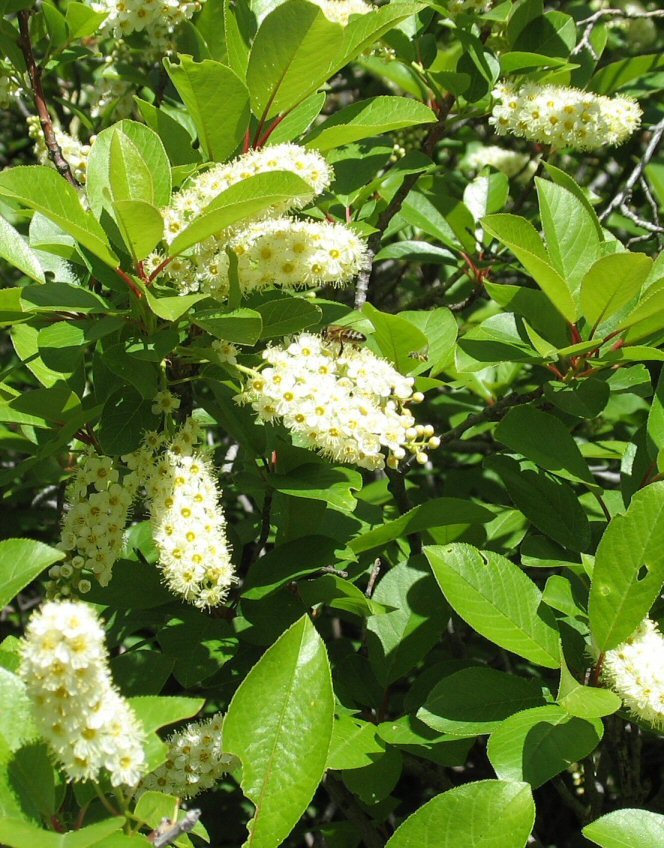
Our story today dates to the Red Rocks Park hike on May 16th. Can a shrub be a "wildflower"? Today's pick is Chokecherry, so see what you think.

Many of our flowering foothills shrubs are in the Rose Family, and Chokecherry is among the most abundant. It's distinguished in the field by its elongated inflorescences and flowers that come after the leaves.

Note that there's a honeybee nectaring on these fragrant flowers (and a smaller bee or wasp behind him waiting its turn). Honeybees are, of course, amazing pollinators, and not only produce honey for human (and bear) consumption, but also ensure the fruitfulness of many other crops. They are, in fact, domesticated servants of humans.

Turns out, just around the corner from this bush is a bee tree. Don't think I'd noticed the hive in this hollow Hackberry before as I'm usually drawn to the witches' broom decorating its branches, but Bee Lady was with me and she pointed it out. The Hackberry is not dead-- yet! These trees are normally very late to leaf out, and it has been weakened considerably by the witches' broom.

Looks like bee heaven to me-- a very short trip from a productive stand of Chokecherry to home and safety in the nearby tree. Foraging just a little further afield will enable these bees to find many more "roses" to pollinate. Our foothills shrubs surely benefit from all this attention!

[I have a nice picture of two bees heading into the tree home, but blogger insists on displaying it sideways. Sorry!]

Here's the rub (why must all our fine ecological stories seem to have a rub?): I learned, or was reminded, last week that our beloved honeybees were interlopers in this country, coming along with European settlers and even leading the way into the wilderness. It is said that the Amerindians were saddened when they saw the bees, because they knew the white man would soon follow.

Wednesday, May 17, 2006

A Prickly Pair

Monday’s walk at Red Rocks Park was full of flowers. With the late snows delaying the earlier species, and the later ones now beginning to bloom, it seemed like ‘everything’ was flowering at once! Or getting ready to. Shrubs, early and late wildflowers, and even a few cacti. I still haven’t caught up with the photos taken May 7th at Eldorado Canyon, but today we’ll have some fresher ones from Red Rocks, May 15th.

Besides the abundant prickly pear, the foothills offer these two ground-hugging cacti. They can be tricky to tell apart, so let’s take a closer look.

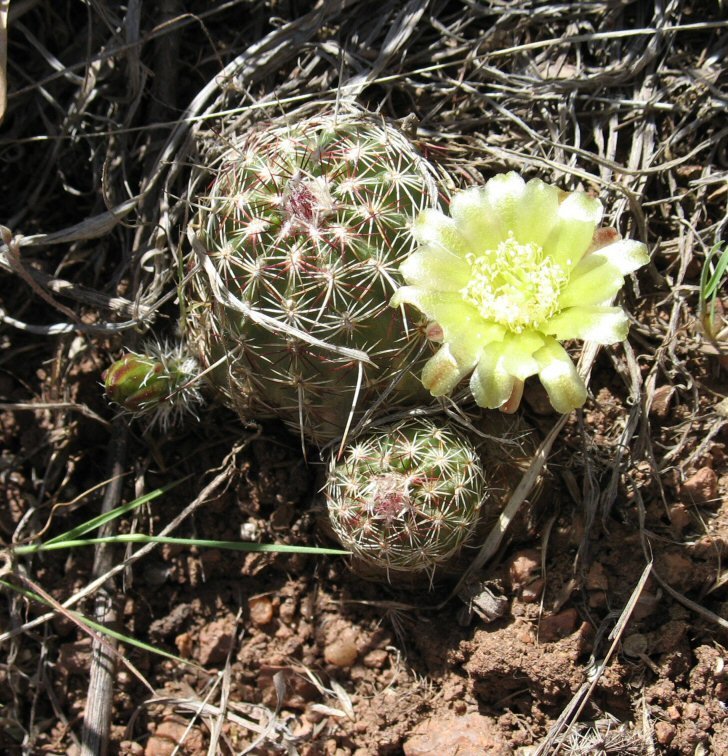
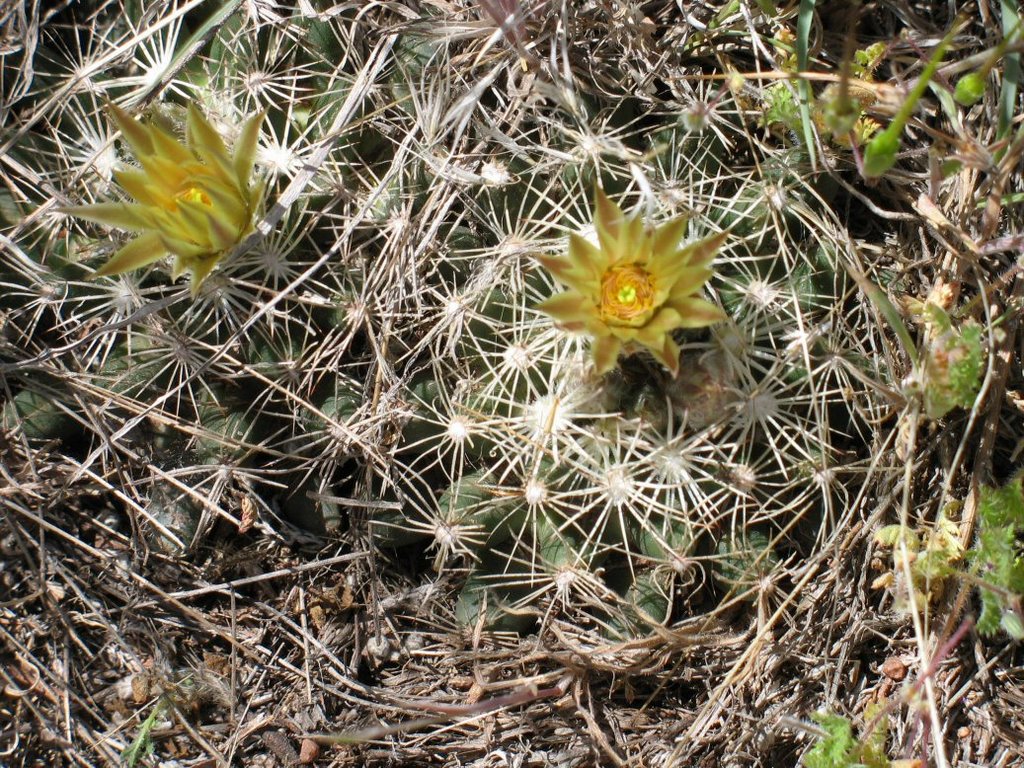
Most common is the “hen and chickens” or “green pitaya,” Echinocereus viridiflorus. (The species name means green-flowered.) It is more likely to grow tall (maybe 4-6 inches) and cylindrical than the second one shown here, and the spines tend to congregate on vertical ridges.

Flowers are just over an inch in diameter, to give you a sense of scale here.

Less often seen, in part because it can be so cryptic, is the nipple cactus, Coryphantha missouriensis. Short and compact, it actually withdraws into the ground a bit during the winter, making it even harder to spot. When in bloom, though, its yellowish flowers give it a little more distinction. The spines occur at the tips of protuberances, hence the name “nipple” cactus. In recognition of this feature, the genus was originally called Mammillaria. A similar species (C. vivipara) has pink flowers and is more unusual in our area.

Monday, May 15, 2006

Top Ten Reasons to Celebrate Mother's Day

We had, as it turned out, an amazing weekend and a lot to be thankful for. So here’s my list:

  1. A visit from the Husband’s Mother, otherwise known as MiL, who spent a happy weekend pulling weeds from the patio pavers.
  2. Knowing that the Other Mother (mine), was safe, well, and reasonably happy at her home on the other side of the Great Divide.
  3. An absolutely gorgeous weekend, sunny and seasonally warm on Saturday though cooler on Sunday. A weekend to be outside, and we were.
  4. The arrival, Husband says, of the Bullock's Orioles, one pair streaking through the yard. Our (well, his) first sighting this year, though others have reported them back for several days.
  5. Not one, but 3, male Black-headed Grosbeaks hanging about to provide company for the females who arrived earlier. We usually get to see the annual babies soon after they fledge.
  6. A BRAND NEW BIRD in the yard, in fact two or more of them, which are reported below.
  7. The digital camera, in the temporary absence of the bird book, with which to seek –and instantly get—a correct identification.
  8. The discovery that our live-in feral cat, Morticia, who escaped on Friday (giving me great cause for alarm), was safe in the garage with Baldur, our current top-of-the-pecking-order male, and the attendant relief when we maneuvered her back into the house last night. (Now if we could just get her fixed!)
  9. A great hike on Saturday, and making it to the top of North Table Mountain (and down again) in my inadequate condition, without excessive rebellion from my knees—and seeing lots of birds and flowers and no more than eight mountain bikers and (on top anyway) no leafy spurge! Coulda been worse.
  10. Seeing that almost everything out there comes in pairs, from the bunnies in the yard, to the finches, sparrows, mourning doves, and orioles, to, memorably, the swooping, cavorting pair of Red-tailed Hawks we saw from the rim of North Table Mountain. It is, after all, the Lusty Month of May!

And, Number 11, if I may cheat a bit, ALL THE FLOWERS!! Even without an adequate supply of April showers, or even March snowstorms, we are blessed with blossoms. Our moisture will, at least, get them started—but we’ll need something more to keep them going.

Mystery Bird of the Day

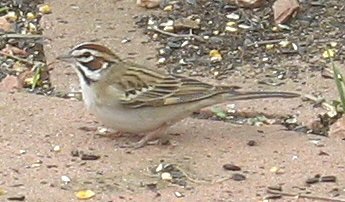
Truly, I had never seen this one before, and (like my first Western Tanager), I nearly laughed out loud! What a face—unforgettable. I was, of course, convinced it wasn’t a sparrow and was toying with some kind of Longspur, but couldn't put my hands on the bird book. Ah well, never said I was a birder. Shortly after firing a few photos off to Bee Lady, Cat Woman, and Hawkeye, all three answers came back within a half-hour of each other. It was unanimous: the Lark Sparrow.

Why here, all of a sudden? Will they stay? And why won't blogger upload the other image without turning it up on end?

There is, apparently, some evidence that bird ranges are shifting. Global warming? Wonder if the real bird folk know? Cat Woman reports that she now sees the occasional Horned Lark, a prairie bird, where she lives higher in the foothills. What else is changing?

Friday, May 12, 2006

More Foothills Gold


A little something for the bird lovers as well as the flower lovers this a.m. This little guy, an American Goldfinch, showed up a couple of weeks ago (4/28/06), right after that killing frost.

Still no orioles, but I did see a male Black-Headed Grosbeak. Lots more gold and orange in our future...

Shrubs for All Seasons

Two colorful native shrubs today offer different approaches to survival here in the foothills. Unlike the foreign ashes, they both came through our recent snows unharmed.

Here, Golden Currant (Ribes aureum) shows the strategy of a plant with northern affinities. Like its fellows in the Currant Family, its leaves start early, sometimes even in March, and resist frost. Flowers follow the leaves.

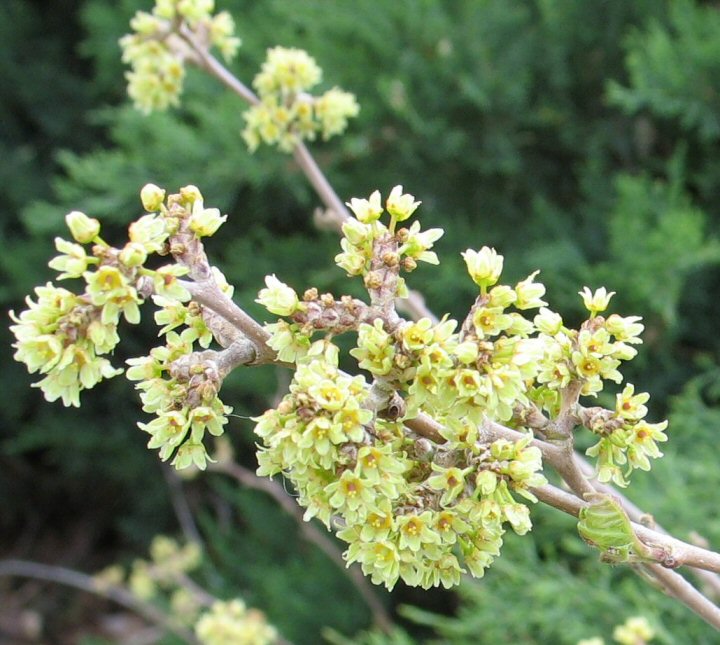
An alternative method is shown here by Skunkbush, or Three-leaved, Sumac (Rhus trilobata, once R. aromatica), which flowers well before the leaves begin to appear. You can almost see a leaf, just getting started, in the lower right of this photo. The flowers, by the way, are tiny, maybe 3 mm across. The Sumac Family has southern leanings, and our sumacs are cousins of cashews and pistachios.

Both these plants are volunteers in my backyard, planted by birds. Both produce small round juicy fruits that birds apparently enjoy and then deposit in likely places. Landscaping made easy!

Thursday, May 11, 2006

Resurrection

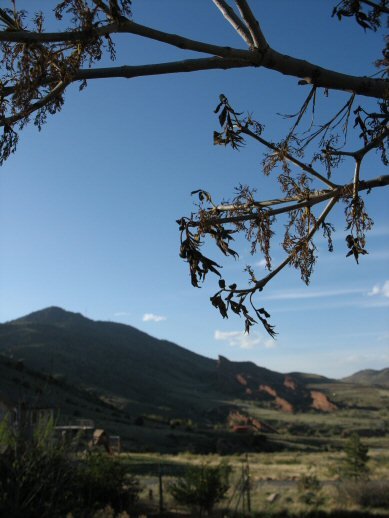
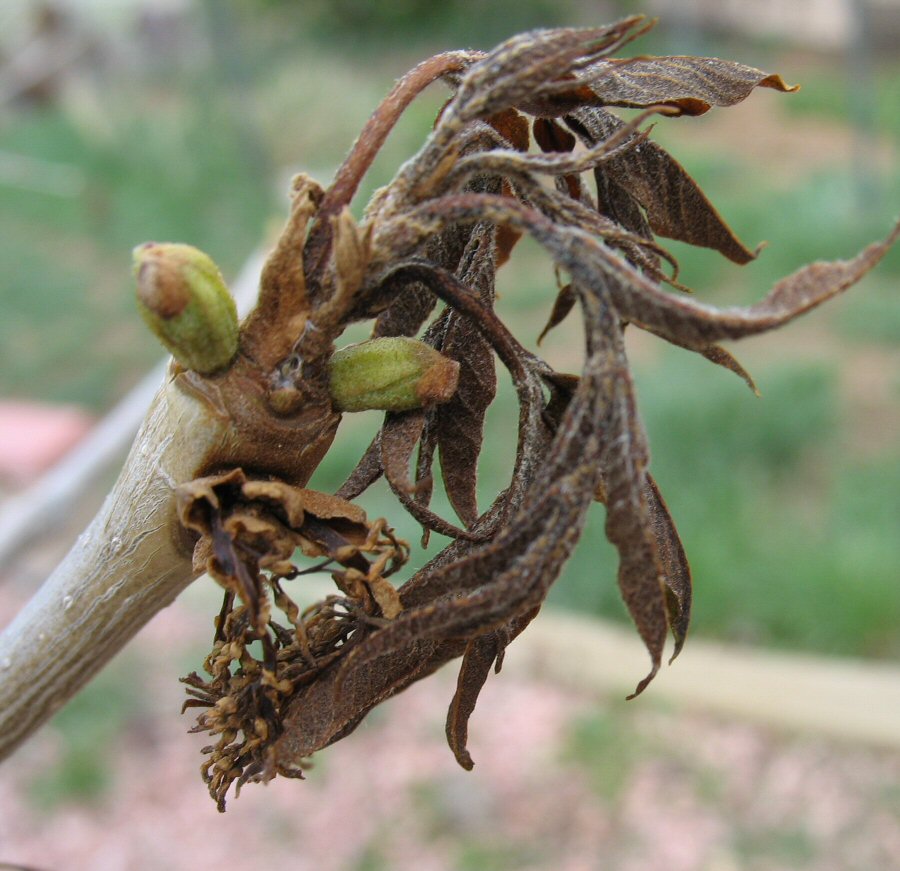
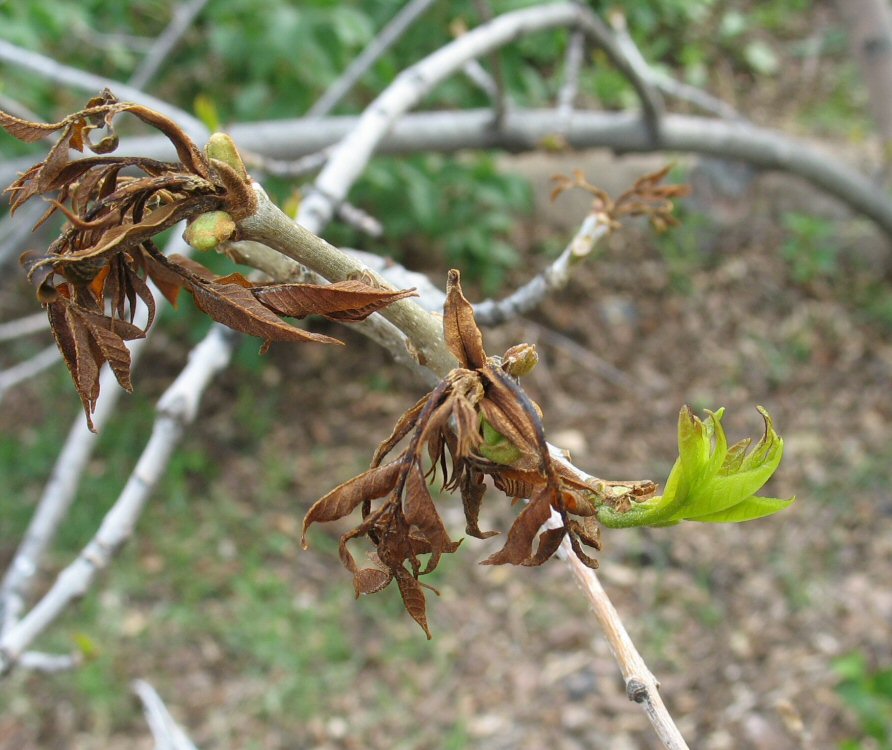
On May 1st, after the "lilac snow" of April 25th, the green ash trees were decidedly not green. They were, in fact, crisp. A beautiful spring day, and all the progress they'd made toward spring was eliminated overnight.

Now it's 11 days later and, even for the ashes, spring is returning. The sequence below indicates steps in the long slow process of starting over.

Wednesday, May 10, 2006

Spring Sunrise, Colorado Style


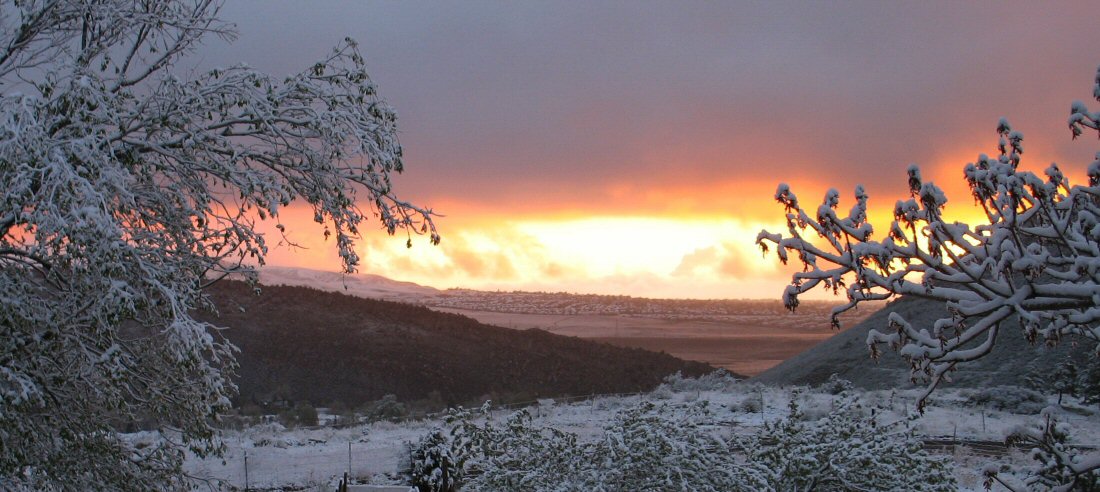
Here's looking at Denver. May 10!! An inch of snow!! Normal in the mountains, but not here! At least the sugar solution in the hummingbird feeder didn't freeze this time. It's a balmy 38 degrees out there.

Tuesday, May 09, 2006

Eldorado Gold

Our spring walk near Eldorado Canyon on Sunday was rich in rewards. Almost every spring flower and shrub imaginable was blooming--enough to satisfy my foothills fancies for a long time! So, finally, it's party time for plants here.

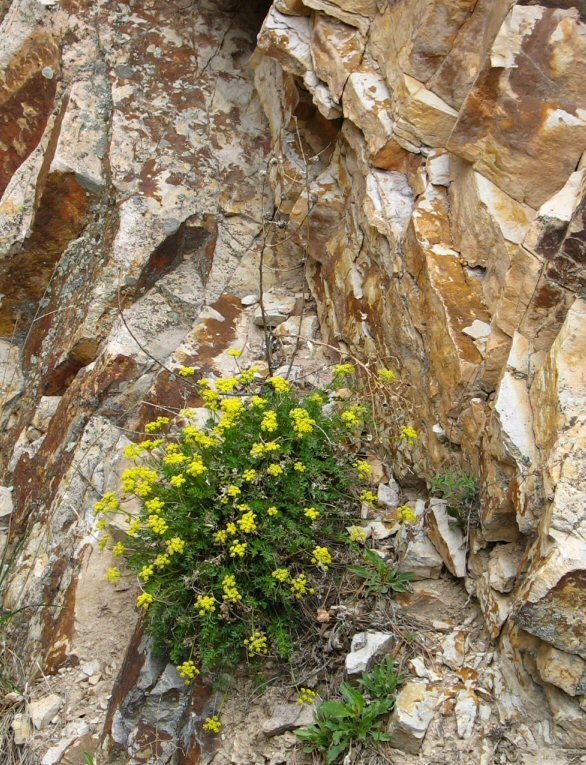
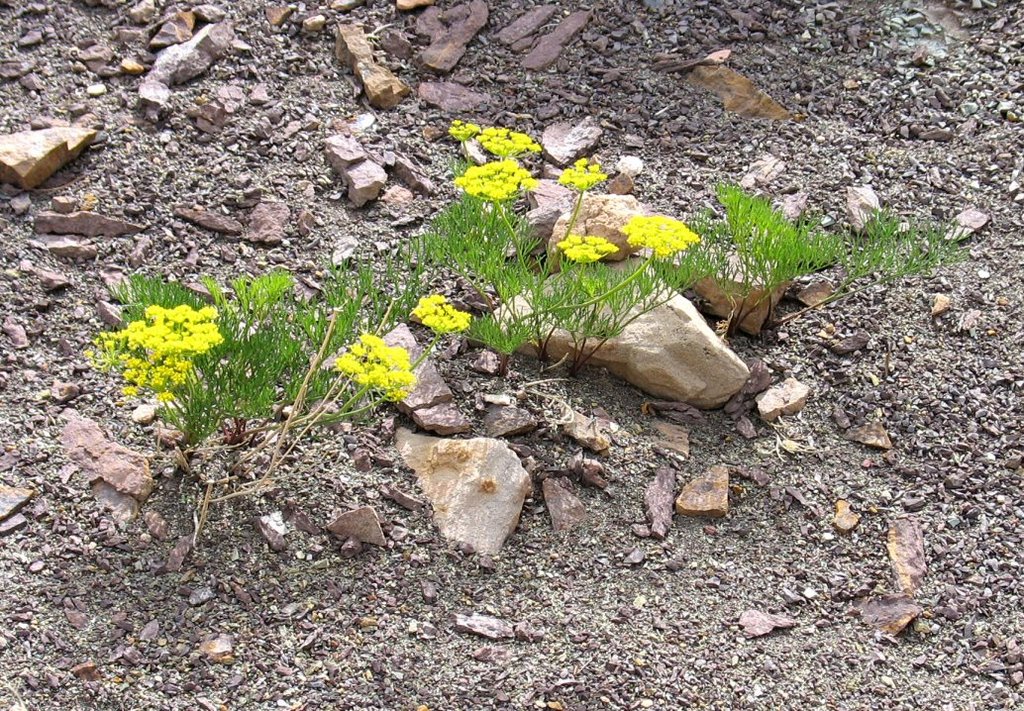
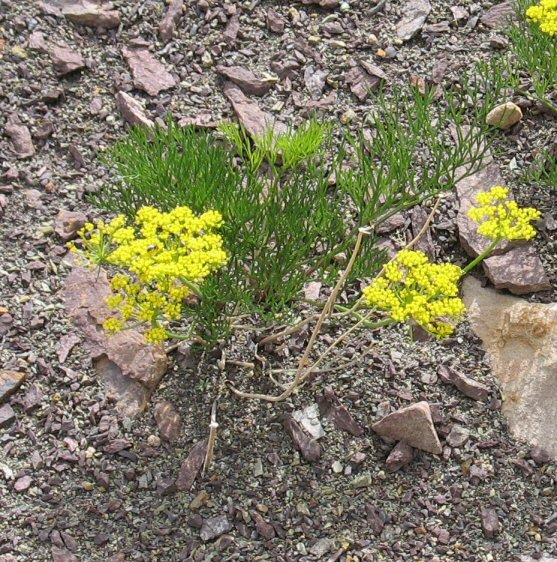
First up are two cousins: Whiskbroom Parsley and Mountain Caraway. In the deadly and delicious Carrot Family, these fall into the Rule 2 category: "don't pick, unless you really know what you're doing." But Rule 1, "don't pick" takes precedence in general anyway! Enjoy them and let them be.


Right: Mountain Caraway, Aletes acaulis, occurs throughout the montane, but clearly is fond of rock walls, banks, edges, and other dramatic options.


Right: Whiskbroom Parsley, Harbouria trachypleura, is also common in montane forests, and can be distinguished by its very narrow, finely divided leaves.

Montane forests, for those not around here, generally means forests mostly of either Ponderosa Pine or Douglas-Fir, at elevations from about 6,000 to 8,000 feet, with Ponderosa on the warmer or lower areas and Douglas-fir on cooler (e.g., north-facing) slopes. These plant communities mingle with shrublands (chaparral) on their lower edges and with dense coniferous forests of many species (but think spruce especially) at higher elevations. Okay?

What's nice about the montane zone, among many fine qualities, is that it's rich in flowering shrubs and wildflowers of its own, as well as some refugees from lower elevations. We'll see some of those in the days ahead.

Friday, May 05, 2006

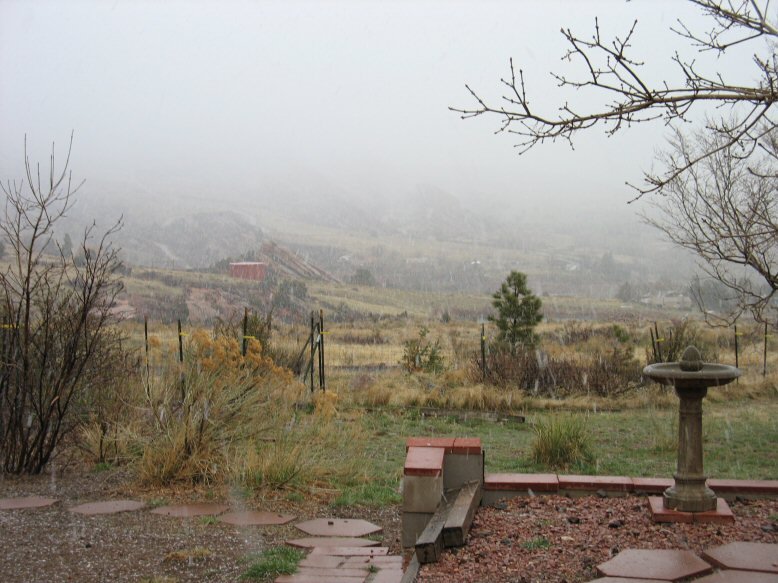
The Usual View

Lost in fog this morning, though we do have a somewhat soggy visitor.

We first met "Baby Doe" in 1998. I remember, because it was a big year for apples and she came regularly to check out (and browse) our two trees and the many fine apples they produced that year.

Then she discovered chicken food, and we haven't figured out how to keep it available to the chickens and inaccessible to her at the same time. Since we've known her, she's raised several sets of twins, partly on pilfered Purina.

I was going to say that we're lost in fog, but really, from my place-centric universe, it's the rest of the world that's disappeared. Nice cozy feeling-- no Denver, no Red Rocks even, out there. And HUMIDITY! Always a thrill in Colorado to feel moisture IN the air. Seems like years since we've had this kind of rainy, drippy May-- and it's most welcome.

Thursday, May 04, 2006

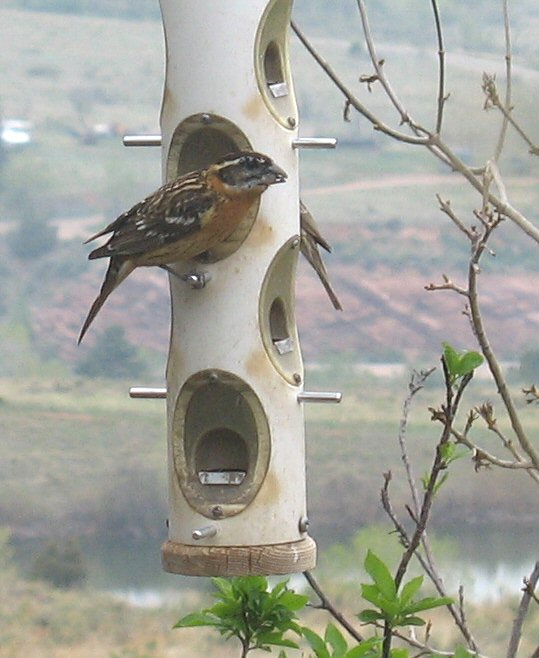
She's Here!!

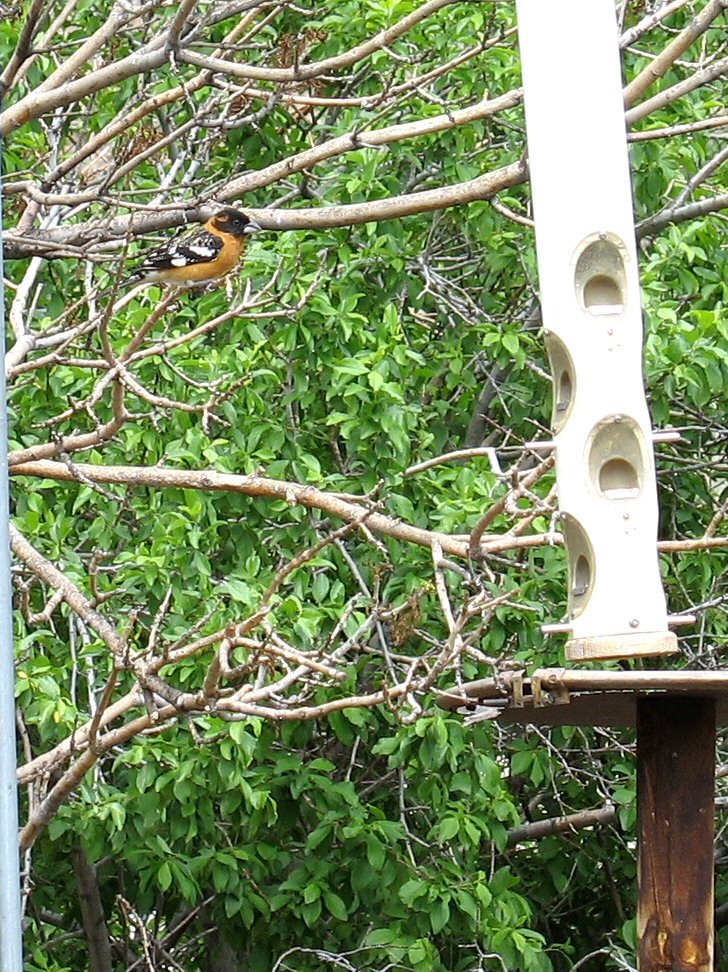
At least I think she's a girl... or maybe an immature. If the black-headed grosbeaks come back, summer is not far away!

So far she's all alone-- and looked a little hungry! Hitting the sunflower seeds hard... She disappeared minutes later, so I was lucky to catch her. Soon they'll be regulars at the feeder.

White-Crowned Sparrows

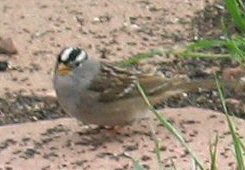
We have a small flock now of these little guys, but they've been camera-shy! Yesterday I was finally able to capture them, though with only moderate results.

Aren't they cute? Like a little flock of chipmunks dashing around out there. Three white stripes and four black ones certainly give them a jaunty air.

Still no sign of grosbeaks and orioles. Got to get out and look for wildflowers! Damp and drizzly today after some rain yesterday-- so it's great lichen weather too.

Wednesday, May 03, 2006

Wrong Again!

Juncos are still here after all. Their numbers are overwhelmed by the white-crowned sparrows, but yesterday there was definitely a gray-headed junco keeping me company while I sat outside. My informants tell me that they don't leave, they just migrate west to higher altitudes for the summer. And the bird book confirms that they do indeed breed here in the Rockies, the whole range just shifts a little west and north with the onset of warmer weather. Just shows I haven't been spending enough time in the mountains lately.

East-west migration is a pretty common phenomenon here in Colorado, where we can always find snow upstream if it gets too hot here in the lowlands. Contrariwise, the Stellar's jays often come down from Evergreen to visit when a winter storm threatens 10 miles up the canyon.

Tuesday, May 02, 2006

Spring is Here! For Real This Time...

Two absolutely beautiful, perfect days in a row. No snow even! Sunday night it actually rained, gave everything a brief but thorough soaking. Followed by more sunny days, but seasonally cool-- no immediate plunge into summer.

Artemis, "our" sharp-shinned hawk, breezed by this morning, a strafing run (or so the chickens thought it). She didn't stop for breakfast, or even pause. Just checking out her territory, evidently. And the juncos are gone. Takes longer to notice an absence, so I'm not sure exactly when they disappeared, but sometime in the last few days. Grosbeaks and orioles have, surprisingly, not shown up yet, but we're looking forward to their arrival. Only a few hummers are here so far.

Sand lilies (Leucocrinum) and Nuttall violets are blooming now, along with the ubiquitous salt-and-pepper (Lomatium). Will have to go check for more signs of spring. Husband and I did see a few pasque flowers on Earth Day, up the canyon at Dedisse Park in the ponderosa forest, where I was checking for my favorite ground lichen, a profusely branched Cladonia I've yet to pinpoint.

And that's all for today...

Friday, April 28, 2006

Here we go again...

It's beginning to look a lot like Monday afternoon out there. See April 07 for photo, I'm not going to do this again! Juncos and hummingbirds are happily (?) coexisting outside, as the temperature hovers at 38 degrees and the flakes keep getting bigger. At least it's wet and, as we Coloradoans always tell each other, "we NEED the moisture."

Wednesday, April 26, 2006

Lilac Snow

Tuesday (yesterday) morning, 6:30 a.m.


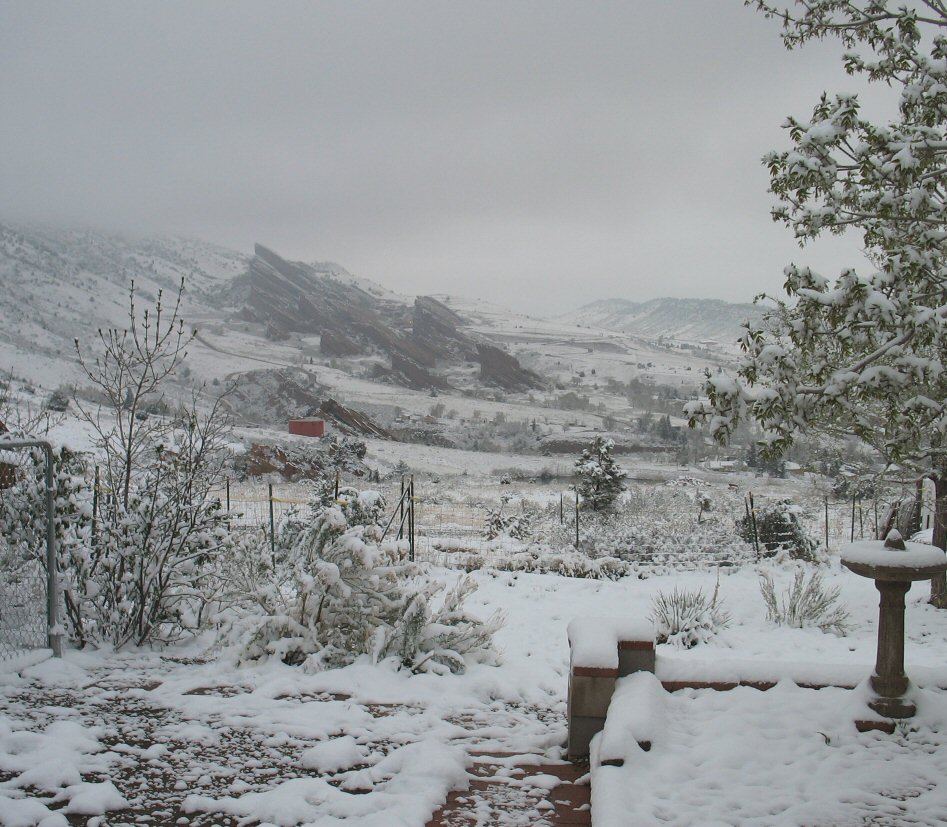
On Sunday it was 80 degrees; I actually considered putting on shorts, got a little sunburn. By Monday night, I was worried whether my lilacs would survive. This is what they looked like Tuesday morning.
A little late for "daffodil snow" this year, we ended up with a real "lilac snow"... and I scraped more than 3 inches off my car yesterday morning.

(Essay on spring snow season...)

Ahhh, Colorado! This a.m., temp is already approaching 44 degrees, and the sky is bright and sunny. Per usual. Mild surprise--the lilacs seem to be coming back to life. The blossoms on the Italian plum and apple will probably be gone; all the flower buds on the green ash trees fell to the ground. The ashes will have to put out a new set of leaves; tender new ones have frozen. Never even saw an apricot blossom this spring; they were killed long ago by one of our cold spells. What about the wild plums? Will their flowers weather the weather better than our introduced fruits? The bears hope so...

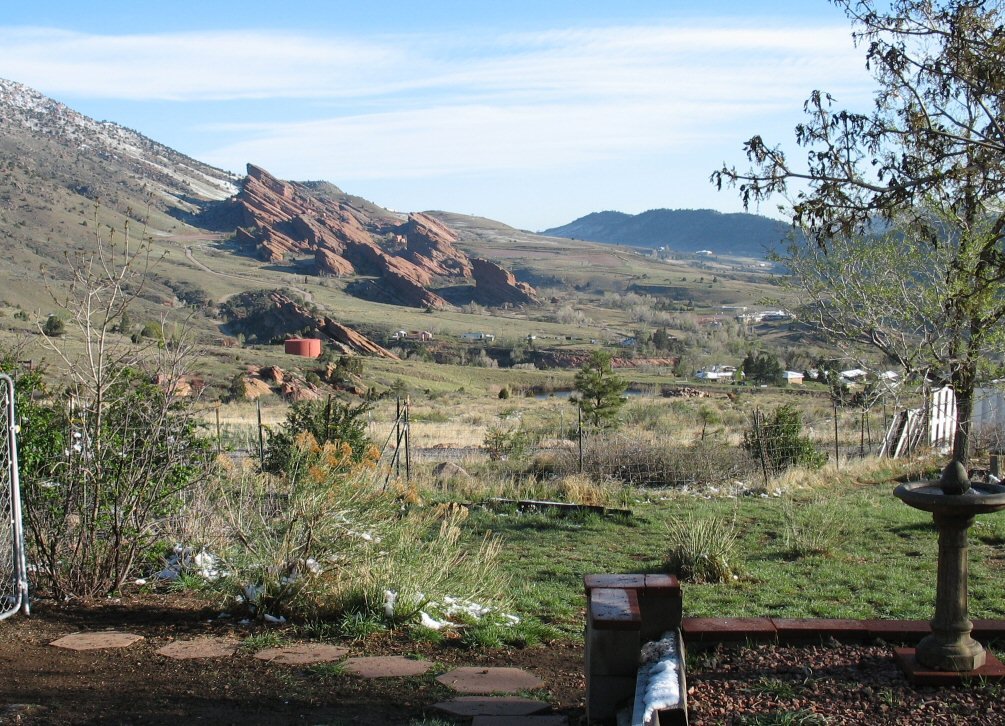
Here's this morning, for comparison.


Just a few spots of white stuff left-- It's as if the world has gone from black-and-white to color!

Valley Birds

Yesterday morning we sat in Lila's sunroom in Morrison, just 200-300 vertical feet downhill, and watched the birds at her feeders. A lazuli bunting, blue as today's sky, showed up! Also a red-breasted nuthatch, somebody I hadn't seen before. But she lacked our white-crowned sparrows and goldfinches. What a difference a mile makes! Here on the hill, we still have juncos, our winter pals.

Saturday, April 15, 2006

Across Colorado

Just a quick note to say that I'm off on the West Slope, so will have an excursion report when I return in a few days. It's snowing this morning on Hastings Mesa, the Stellar's jays and magpies are hanging out in the tree tops looking for handouts. Bears are out of hibernation, one was spotted this a.m. Lots to tell when I get back!

Friday, April 07, 2006

Spring Snow...

It's only been a half-hour, but the snow "flakes" (more like balls) are now almost 3 cm in diameter. Very cool!

Gray Day Turns White

As I was saying to the Husband this a.m., "looks like there's moisture in the air out there." Green Mountain in the distance was obscured by a hazy film suggestive of air you can't quite see through!

Then, it rained for a little while. How exciting! Rain is a relatively rare event here--yesterday I virtually did a rain dance in the parking lot at the office because there were sprinkles on the pavement. But today, actual rain was slanting down.

Now it's turned into fat white globs and is pelting gently down. I neglected to check the temp when I got up, but it's currently hovering at 38. Balmy. Here's the view as of 7:39 a.m. The white globs will show up better if you click on the picture for a larger version.


Yes, that's Red Rocks in the distance. And what's that in the foreground? Can it be? Yes, I think... it's... GREEN!

Wednesday, April 05, 2006

Nature in the News...

Every once in a while, Nature does make the news. How rare this is (apart from drastic weather) seems to be a measure of our distance from the natural world. Today we have two posts about Nature in the media.

Unfortunately, it seems to me, the evening news-- along with most of our society --only notices Nature when human plans or goals are being somehow interfered with—hence the “pesky” flickers, below. Have you noticed how often we remark—and resent—these small signals that events in Nature are healthy, that reproduction is still going on?

Pesky Flickers!

The bunnies aren’t the only ones feeling hormonal surges. The Husband reports that even the evening newscast picked up on the fact that flickers are also exercising their territorial and courtship prerogatives lately. It’d be hard not to notice, when almost every time I step outside, the sound of drumming is in the air.

Given more to solitude than flocking, flickers were forced to develop long-distance communication. Living close to hollow trees, male flickers took to drumming to attract the female during those seasons when togetherness is called for. Ah, spring! So here they are, in town and country, finding our hollow houses and chimneys more than adequate substitutes for the growing shortage of hollow trees. At least that’s the way it looks to me.

People tend to notice large woodpeckers pounding on their houses, especially early in the morning. Even people who ordinarily aren’t too attuned to Nature get the message. Rejoice—it’s spring!

One of our resident flickers took to drumming on a bluebird house we’d installed years ago. (Hope it wasn’t occupied.) Evening before last, we were pleased to see that he’d had some success—two flickers were chatting in the big elm tree. Bobbing heads, making a new (to us) flicker noise. Not the common call or alarm clacking as they fly, but a more subtle sound, the cooings and murmurings of growing affection. Can young flickers be far behind?

March Madness

I meant to write about March madness, and here it is, April already! The cultural form of March madness is over. I remotely sensed it had something to do with basketball, but fortunately I got to witness its origins in my front yard, so I have a better understanding of the etymological roots of the disease.

Beyond the temptation of alliteration, March madness has a fine pedigree, dating to 1546 according to Wikipedia. The phrase might have died out long ago (along with “mad as a hatter”) had Lewis Carroll not reinforced it in 1863 in Alice’s Adventures Underground, beloved to modern readers as Alice’s Adventures in Wonderland, and thus ensured its continuity into the present day.

Why is the March hare mad? First, recall that “mad” comes down to us mostly as a synonym for insane, senseless, illogical. Only later did it develop its current common use as angry.

In short, the March hare has spring fever. Clearly March madness has something to do with those passions that erupt in spring, as the breeding cycle begins. Our local cottontails are always a bit impulsive, dashing under cars and such—but last month they were truly senseless, more willy-nilly than ever, and seemingly without provocation.

One morning I looked out to see a pair of cottontails chasing each other. Finally one stopped short, stood up, and boxed at the other, all part of the March madness, I assumed. Sure enough, says Wikipedia, “unreceptive females use their forelegs to repel overenthusiastic males.” So perhaps the poor male March hare, a rejected suitor, has reason to be angry as well as “mad!”

Tuesday, April 04, 2006

Feeder Cam

Another visitor to add diversity to the birdfeeder watch this a.m. I don't know what it is with these little birds, but we have noticed them much more frequently in recent years. When we first moved here more than 20 years ago, we never saw any of these. Must signal some change in migration patterns.

Here he is-- forgive the photo quality. It's a gray day today (we're hoping for rain), and I didn't dare open the door for fear of spooking this new visitor so I shot it through the glass. (Doubtless my photos would improve if I'd just wash the windows, but what fun is that?)


Our rehabber friend CarolG has better bird stories than I do, so I think I'll work on a new piece for my neglected history blog this morning. For a good bird story, featuring bunnies from the inside out, see her comment on yesterday's post. Warning: content may not be suitable for bunny-lovers, but is a great read for those who take the bird's perspective. It's sad that CarolG has no time to start her own blog--but fortunately my posts seem to inspire her! Thanks, Carol...

Monday, April 03, 2006

Speaking of Predators, part 1

When we first got chickens (back in 1996), I knew we’d be getting better acquainted with local predators. I just didn’t know which threats would prove the biggest challenge. We used to have lots of skunks, for example—but they seemed to get along fine with the chickens, even developed a taste for the feed, alas. We still occasionally smell skunk around or under the coop, but they have not been a threat. Raccoons, foxes, no problem. We’re too far from water for regular raccoon sightings, and foxes have rarely put in an appearance. Knock on wood.

April is the time of our annual visits from predators, so this month always makes me nervous. It’s spring, everyone’s either got babies to feed or is looking forward to having babies to feed. It’s a hungry time of year, I understand that. I also get that we’ve become members of the local ecosystem and have to pay our dues. So today’s chat is a bit grim, but not gruesome, I promise. I won’t inflict the entire reality on you.

The first deadly visits we had were a surprise—they came from the air. Chickens are very alert to anything that moves in the air, and will give the alarm whether the object in question is a pigeon, or hawk, or airplane. (They are a wonderful aid to bird-watching: as soon as I hear this special sound, I look up and am usually rewarded.) A small hawk perching nearby, as Artemis does, makes them nervous but doesn’t unduly alarm them. Perhaps they know somehow that she’s after smaller game.

In the early years, the chickens used to have the run of most of the open front yard. That changed in April 2001, when one of the local golden eagles discovered them. One night we came up short on the evening “beak count.” It snowed, though, so it was a day or two before it melted off and we found the evidence. We couldn’t be home all day, and the eagle returned about weekly for awhile. I think we lost about 4 chickens in all. We finally got smarter, and built a new fence to confine the chickens in a smaller space that had more tree and shrub cover. Eagles can’t maneuver well in tight spaces.

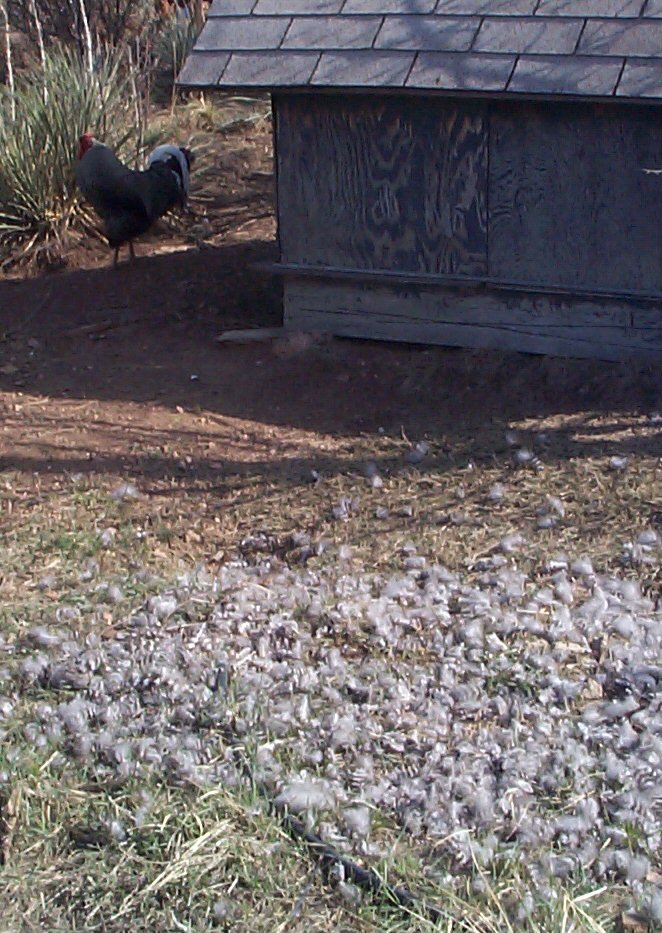
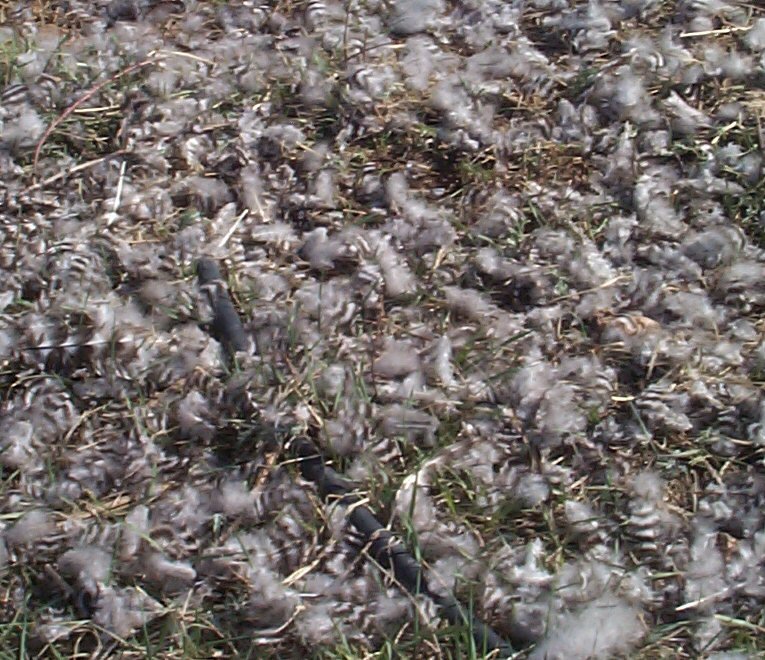
Barred rocks are one of our favorite breeds. The hens are sweet, friendly, productive, and hardy—you can’t ask for more. This is what a barred rock looks like after an eagle is done with her. (Note there’s a live barred-rock rooster in the background.) Very tidy: no body, not even a speck of blood.

This neat circle of feathers is, by the way, a prime way to tell a bird kill from a carcass killed by a mammal, as the latter usually don’t bother to pluck their prey. If they do, they pull the feathers out in mouthfuls, so you generally find clumps stuck together by saliva. Given time by my absence, the eagle carefully plucked each kill, presumably ate at leisure, and carried off the remains of the meal. Back to the babies.

The difficult times are when you hear the alarm and, roused by continued squawking, run outside to see what’s the matter. That, of course, spooks the eagle, who promptly takes off. You’re left with a dying bird, and the eagle still has to find lunch elsewhere. That’s a no-win situation. Much cleaner if you can muster the restraint to stay inside until it’s all over.

Sunday, April 02, 2006

Two-Coyote Morning

Always a good idea to look outside before letting the dogs (or chickens) into the yard. Sure enough, there was a coyote on the rocks just to the north of our property fence. Just ambling through, checking to see if she could find any mice in the rockpile. Sniffing along, wandering through the grass, after several minutes she disappeared down into a nearby gully.

Finally I let the dogs out, then turned the chickens loose into their yard. The dogs did find a rabbit, who made a wrong turn but managed to get through the fence after a brief but merry chase. Then a second coyote wandered down the drive along the east fence, exciting the dogs to new levels of enthusiasm and making me wonder whether the fence would hold them. Unperturbed, the coyote moseyed past, secure in the artificial distance the fence added to the 20 feet that separated him from the dogs. Although he too soon disappeared over the immediate horizon, the dogs remembered him for a long time, staring off in the direction of his departure.

Coyotes doubtless visit here more often than we actually see them, although one morning we woke to see a couple about 10 feet from the front door, eyeing the chickens and drooling. They slipped through the fence, no problem, when the dogs went out—but that was too close for comfort!

One morning two weeks ago, I saw the coyote walking by along the same fenceline. She checked the deep grass by the drive, froze, pounced, then came up with a mouse that she downed in one gulp. Breakfast? No, only a snack. She continued on across the neighbor’s back lot, circling and sniffing, then back to our fence, where she found another rodent. More of a two-bite size, it took her a few seconds more than the first. The magpies closed in, but she left them nothing.

I once thought getting to observe an act of predation would be extremely rare, but it is merely unusual.