Showing posts with label snakes. Show all posts

Wednesday, August 26, 2009

Three and Counting...


One visited while I was gone early this month and was dealt with by the Darling Husband... but Number Two arrived the day after I got back, on August 10th.

Here she is, awaiting relocation, and none too happy about it. If she only knew the reception she'd find at most homes in our area, she'd stop complaining.

The dogs found the first two,* but I found the next one all by myself. Number Three of 2009 was curled up in the chickens' feed trough on Saturday, August 22. He didn't look too happy with me, though I certainly kept my distance, as did the chickens, until DH arrived to help corral him. He, too, found a new home not too far away.

*They've both been quite the snake-pointers ever since #2 Dog survived a bite back some years back. Or, I should say, #1 Dog points, #2 Dog runs for the door.

You may click to enlarge, if you'd like a closer look.

As you've probably guessed, we have a nonagression treaty with rattlesnakes. I'm not finding that to be common, but I have encountered some folks who agree that they should be allowed, most often, to go about their business, as they will if we exercise a little restraint.

They're certainly unnerving, though. I'm never sure their intentions toward me and mine are as friendly as mine toward them. (Come to think of it, these two look a lot alike! Hmmm....)

How many more such surprises before cold puts a temporary end to their visits?? How much longer should I walk, mindful of their potential presence every time I'm outside?


Crotalus viridis.

Sunday, May 24, 2009

Scales and Tails

One of the things I notice about reptiles, in comparison to birds for example, is they’re so quiet! That probably contributes to the notion people have that they’re sneaking up on you, inspiring that zero at the bone sensation Emily Dickinson describes so well.

It also means we have to be more observant this time of year. I think of rattlesnakes now, every time I’m out in the field, trying to be more conscious of potential hiding places. Apparently a child was bitten last week on Morrison’s main street, so it’s officially snake season—and they can turn up anywhere.

For some reason, as I drove home Friday, I wasn’t thinking of snakes. My mind wandered, and I had to slam on the brakes near our driveway to avoid hitting a nice young 3-foot Bull Snake. Time to start carrying a stick in the car again for moments like this. I found an old stalk of yucca and spent a few minutes encouraging her to leave the right-of-way where she preferred to bask in peace. Should have just picked her up; the bite is harmless and not that painful, and she seemed mellow, but why court trouble? By the time I returned with camera a few minutes later, she had disappeared as silently as is usual. [No, I have no idea whether she was really female, but one has to choose, “it” is just impolite.]

Happily, another opportunity presented itself later in the afternoon. We were sitting in the backyard when the Husband picked up the sound we dread. Rattlesnake! Starbuck, the snake-pointer, heard it too; he went on alert, showed us the spot, and barked to let us know he was holding this intruder at bay. (He has a special bark just for unusual occasions, most often a snake. He's also turned up one box turtle and one tomato worm. Very exciting.) Husband checked, diagnosed “No, Bull Snake,” and we all breathed a sigh of relief. Once the dogs were inside, we got a closer look at my second bull snake of the year.
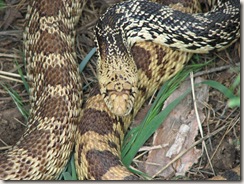
Bull SnakeBull Snakes (Pituophis catenifer) regularly imitate Rattlesnakes (here Crotalus viridis), and, as they look somewhat similar, many people confuse the two. To me, Rattlesnakes just look mean; something in those ridges over the eyes gives them a brooding sinister look, like crocodiles. Chris, at Coyote Crossing, has a nice picture of one of these “sweet and noble animals.” Good story, too.

I like rattlesnakes too, long as they’re not sneaking up on me! I like to know where they are. Rattlesnakes are, of course, one of the few reptiles that let you know where they are. Sometimes. I bet 90% of the rattlers I encountered when I lived in Arizona never made a sound. My theory is that rattling, these days, is behavior that can cause you to lose your head, and  thus we humans have been deliberately selecting for rattlesnakes that prefer not to rattle. That’s why it pays to keep your eyes open too. Here's a prairie rattler recording, for reference.

large Bull Snake in mid-hissBack to our visitor: What was it the Husband heard, if not a rattlesnake? Bull Snakes can mimic the rattle of their model by shaking their tails in dry weeds, but also by hissing. This was the first time I’d heard a wild bull snake make a sound so much like a rattler, so near perfect I didn’t believe DH at first but had to see for myself. As we discovered, hissing was the only “vocal” opportunity this snake had; an accident had cost him the last few inches of his tail.

As long as we can see the whole snake, or most of it, a little attention to detail increases our comfort. The overall gestalt that says Bull Snake includes a long streamlined body (as opposed to the stockier form usual in rattlesnakes), a narrow innocent-looking head blending into a neck of similar dimension (unlike the so-called “triangular” head and narrow neck of rattlesnakes), and tapering pointed tail (rattles blunt the tail tip, even in young rattlesnakes). Stocky is relative. Bull snakes are our biggest snake here in Colorado, so they can get very hefty when they reach a length of 5  or 6 feet (1.5 m or more). The girth of this one was probably 7 or 8 inches (17-20 cm). A rattlesnake that big around would be much shorter, maybe 3 to 4 ft (1 m). Of course, rattlesnakes’ eyes also have vertical pupils, unlike the round ones in the mimics, but do you really want to get face-to-face with one to check that feature?
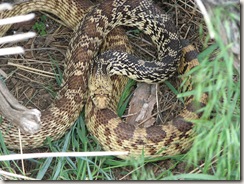
Bull Snake, ready to strikeBehavioral cues contradict visual evidence. Wild Bull Snakes may be harmless, but they’re determined to make you believe they’re dangerous villains. They can hiss, “rattle,” coil, and strike in very aggressive fashion when cornered. Here he’s got his neck pulled back warning of a fast strike that will make you jump no matter how cool you are. Too often, such tricks get them killed, eliminating the ecosystem services they provide, such as rodent control, and, I’m told, rattlesnake control.

Most people are willing to believe any patterned snake is a rattlesnake.  This little baby Yellow-bellied Racer (Coluber constrictor mormon) was found at the local juvenile Yellow-bellied Racerelementary school. They called us at the museum: “we’ve got a baby rattlesnake, help!”
These guys are even called “pugnacious” in the guidebook, so it’s easy to believe, again, that you’re dealing with a dangerous predator. Even at 15-18 inches (+/- 40 cm), this little fellow was a handful. Jace at Nature Journals describes the rattlesnake-mimicry racers will perform. I’ve never seen them tail-buzzing myself, but then I’ve never tried to confront one in the wild as he describes in his last paragraph. For a nice collection of photos of juvenile and adult racers visit California Academy; the adults are completely different. After our photo-op, we returned this little guy to a safe place a little farther from the school.

juvenile Western RattlesnakeHere’s the real deal. A baby Western or Prairie Rattlesnake (Crotalus viridis) looks about the same as the adult and can vary in color from gray-brown, as here, to yellow or greenish. This baby has recently had a big meal.

Diagnostically speaking, note the narrowness of the neck compared to the head, and the black tail near the rattles.

The rattlesnake I encountered at the chicken coop last summer was a clear green. Just lovely… as long as I knew where he was. Thankfully, that one did rattle at me. To this day, I still expect to see him every time I go out there, now that it’s spring.

By the way, a good resource for Colorado reptiles and amphibians is the Colorado Herpetological Society, especially their identification guide. Extensively updated since my last visit, it’s a great site.


Wednesday, April 16, 2008

Spring, Distractions, Other Goings On...

Although I've been scarce here lately, I'm getting back in gear, what with Berry-Go-Round coming up in a week or so. Please send contributions by April 25th! Any post on plants is welcome, but especially those on spring wildflowers to help celebrate the seasons. Those who have been working on taxes are out of excuses! See previous post for details.

My focus these last few weeks has been history, with our open house coming up. It happened Saturday (Apr 12th), and I put a report up at Local History Explorer.

It has been decidedly spring-like since Sunday—warm, sunny, and magnetic outdoors. An irresistible pull to go for walks, check out wildflowers, pull some Dalmatian toadflax... I let the black widow loose in the woodpile, optimistically thinking we won't be disturbing her til fall. Yesterday, temperatures reached the mid-80s (high 20s C). Today, "they" tell us, it's back to snow and rain. At least it should bring a little (temporary) relief from the pollen!

Next up is a hike for a Green Mtn. homeowners group this Saturday a.m. I expect more weeds than wildflowers, but hey, it's all educational. As Herb Quarterly reminds me, we could consider them medicinal aids instead of invasive plants; it's all a matter of changing perspective. Isn't everything? Would it be too fatalistic to conclude we will have to get used to this homogenization of ecosystems? I'd like to drop in to Earth Day festivities at Evergreen, too; the new nature center there will be launched.

The Husband has decided we need to have a garden. Oh my. The prospect is appealing, certainly, and an excellent response to his indoctrination by Michael Pollan on the importance of eating well (he's been reading In Defense of Food). The fact that we're on well water, and not much of it, will make the garden of his vision a real challenge. Regardless, among yesterday's errands, I bought seeds. Hope springs eternal.

The snakes have been restless. Must be spring. The smaller one has been eating fairly regularly for a couple of months; the larger has yet to break her seasonal fast. I was hopeful; brought home food yesterday. She curled up in the dish with a few baby mice, but declined to nibble. So it goes. She'll have to decide to eat soon, but her weight is holding so I guess we're okay for the moment.

I spent a couple afternoons helping the Artist take down her bread exhibit at the Conifer Library and set up a new one on fly-fishing. She sent me home with a large shopping bag of dried-out artisan breads in assorted styles, so the chickens have been having a major carb fix. The croissants were greatly favored. The flock is also enjoying occasional forays into the front yard, where there is green grass coming up. I'm testing a theory that they might be good for controlling cheatgrass. The Husband has agreed that we can get new chicks this year, so that means more fresh eggs come fall! (Our 14 aging hens produce only a few eggs a day now...)

That's enough!—just a few of the slices of life around here recently.

Sunday, January 06, 2008

Waves of Land

Update June 2011: I found the poem!! I have edited it below for accuracy to the original version, though I happily note I was spot on for the first half, and in order to give proper credit to the author. Added lines are in color.

College Freshman English. Required, even of science majors. Though I was initially reluctant, it turned out to be the moment when literature (after some dismal high school experiences) finally made sense. The Norton Anthology, though grueling, was an eye-opener. John Gardner’s How Does a Poem Mean? became a Rosetta stone, inspiring a lifelong love of poetry that might otherwise have died with childhood. But one poem, not in any book, stands out in my memory.

Google found “about 386,000” results when I asked it for snake poems. Poetry.com found only 86 snake poems, a more manageable list. As I scanned the latter results, I missed Dickinson’s “narrow fellow,” though it must have been there. Finally, after honing my search skills on key phrases, Google reported that:

Your search - "raspberry vines and air" - did not match any documents


Google? Stumped? If it weren’t so firmly entrenched in my memory, I’d think I imagined this poem. Fortunately I can remember much of it, though the couplets are undoubtedly out of order in my head, except the first and last. It is a parody of a familiar poem, but executed with far more grace of technique and clarity of metaphor.

I think that I shall never make
A poem sinuous as a snake:
A snake that can us mammals mock
Whenas he moves upon a rock;

Whose muscular and graceful strength
Dwells in the one dimension, length;
Who has no radiating limb
And yet on waves of land can swim;

Who can, from raspberry vines and air
Devise himself a rocking chair;
Who worships silent in the sun;
Who has no projects to be done;


Who thinks no thought, who makes no sound
Preferring to remain profound;

Who though from dust he scarce can rise,
Appropriates man’s paradise.

I strive, like Adam, every spring
To conjure that elusive thing
An Eden, with my hoe and rake
The serpent only God can make.


—Donald Babcock


Why this poem? Why today? See the following post. And if you know this poem or its author, please let me know! Thank you, Mr. Babcock, for the years of enjoyment knowing this poem has given me.


Bouncing Back to Snakes

Snakes have always been on my list of most beautiful beings. I was intrigued with them, but it wasn’t til I was in college that the fascination turned practical, and I lived with a snake my entire senior year. Much later in life, I cared for a dozen or two snakes of different native species at the museum where I worked for more than a decade, sharing all phases of their life cycle from conception to death. And worrying constantly: were they warm enough? Cool enough? Humid enough? Hungry or overfed? Healthy or sick?

Snakes, and reptiles in general, are so foreign to us. Their condition or status is often signaled by subtle behavioral cues, unlike the mammalian expressiveness of most of the animals we take into our homes. Yet they are often portrayed as “easy pets,” needing little attention or care.

After two snake-free years, again I find myself managing the care of two fine snakes, Rubber Boas this time. Small, secretive, and relatively slow as snakes go, these two are an entirely different experience. This morning, when I entered the study (where the Husband insists I keep them), they reminded me of the poem above. Two coils of boa were visible above the substrate in their cage. Like Nessie swimming in the loch, the small boa was porpoising along the bottom, neither head nor tail visible, swimming on waves of land. I had to watch closely even to tell which direction she was going.

As she continued cruising, I decided to take her out to spend a few moments getting acquainted. It was cool in the room, and she coiled herself around my wrist for warmth, just as described at rubberboas.com She seemed content to sit quietly there for awhile, though perhaps disconcerted by the occasional swish through the air when I carefully moved my arm. It was awkward-- next time I’ll put her on the left arm so I can use the camera with my right.


Speaking of heads and tails, as you can see, it’s hard to tell with these critters. Blunt tails and small heads are protective, an attempt to trick a predator into picking on the wrong end. The tail is also used to defend against the attacks of the mother mouse when they’re stealing babies from her nest for dinner. A result of these tactics is that the snakes, in the wild, are often heavily scarred. The larger of my two, who doesn’t like to come out much, has extensive scarring on her tail, but this one is almost unblemished.