Arizona introduced me to vultures when I was about 22 years old. In those days, Turkey Vultures (Cathartes aura) hadn't yet penetrated the habitats of upstate New York where I grew up, so I had to come west to make their acquaintance. Because they were new to me (as were many other living things in Arizona), they were automatically fascinating.
Parts of the desert landscape, too many parts I'm sure, were home to cows, and often some of those cows were recently deceased. Not until I reached the desert grasslands of southern Arizona, though, did I see vultures in numbers. I captured this photo back then, probably somewhere between Elgin and Fort Huachuca.
Unlike other raptors, Turkey Vultures are happy with a cold buffet, one that Nature quite regularly lays for them. Everything dies, and everything must be recycled, sooner or later, one way or another. With vultures, it's sooner. They may not always come first to the feast, but once they arrive, other feathered scavengers must move on, or be adept at dodging in for leftovers.
Unlike most birds, Turkey Vultures have a keen sense of smell as well as eyesight, quickly finding new sources of food. Their range expansion northward in recent decades has been attributed to climate changes, increases in open habitat relative to forests, protection from hunting, and, my personal favorite, opportunism as a result of our expanded highway system. More and better roads--> faster speeds--> more roadkill--> vulture habitat improvement! An ironic and unintended benefit from our continued environmental deterioration.
There's a nice article on range expansion here, as vultures return to Vermont. Turkey Vulture populations are apparently strong, unlike other vultures in other parts of the world. Thanks to the folks at IVAD, who are working to create awareness of conservation needs of these fascinating birds, without whose help we'd be hip-deep in rotting carcasses!
Check out more about vultures over at IVAD headquarters. See, especially, Tai Haku's contribution, which is loaded with excellent photos and a timely reminder of appropriate human funeral customs.
Saturday, September 05, 2009
Blogging for Vultures: International Vulture Awareness Day
Sunday, August 30, 2009
A Pepperweed Adventure
Happily for me, though, Perennial Pepperweed (Lepidium latifolium) was not the only plant we encountered that day. Here the pepperweed, which was not yet blooming, consorts with Poison Hemlock (Conium maculatum), another exotic, in full flower.
This post doesn't qualify for Plant of the Week; perhaps I should call it a "plant of last month." Late July and most of August were absorbed, it seems, in the wink of an eye! Forgive me for taking you back to early July for this little botanical adventure.The first few plants we uprooted seemed innocuous enough, but I latched on to one, near the base of a small ponderosa pine, that soon delivered an extensive root system. Perhaps the mother of all pepperweeds...
According to one reliable source,
"Perennial pepperweed is a highly invasive herbaceous perennial. It can invade a wide range of habitats including riparian areas, wetlands, marshes, and floodplains. It adapts readily to natural and disturbed wetlands. As it establishes and expands, the plants create large monospecific stands that displace native plants and animals."
So far so bad. The good news is that, in the course of an hour or so, the two of us seriously depredated this patch of pepperweed, leaving few, if any, survivors above ground to reproduce. The bad news is: it's perennial. As we wandered the area, looking for any surviving remnants, we noticed an odd distribution pattern: it seemed to be associated with the pines. Here it also shows a bit of a zonation pattern, with hemlock behind, pepperweed next to the pine, and smooth brome in the foreground. Lovely.Clearly we were not in a pristine ecosystem by any means. This is a park that is rapidly gentrifying, and has been used for almost a century. We were also right next to a "park and ride" for the local bus system. In beautifying the area around their new parking lot they had, logically, planted "native" ponderosa pines from a local nursery. (Though why they didn't use the many native pine seedlings on site, I can't explain.) We speculated that the source of the infestation was the root balls of these imported trees. Upon being informed of its presence, the bus company promptly mowed the entire area. Problem solved, right? Well, maybe...
The Park Service (source above) adds:
"Application of the control plan must be repeated numerous times to obtain lasting management.... Sources of infestations should also be located and eliminated to prevent future infestations.... Mechanical control options are typically not effective. Very small patches can be controlled by hand removal if the process is repeated often for several years and plants are not allowed to mature."
Looks like we have our work cut out for us. We have a chance, with conscientious monitoring at this site, to prevent this weed from gaining a foothold that will overwhelm our ability to deal with it in the future. It's early, here, for this one. Perhaps we won a battle, but vigilance, eternal vigilance, is the key in this war. Fortunately, some of our aggressive invaders are not so intractable.
Here's the meadow at Bergen, looking back into the park (a ponderosa pine grove). The brown seedheads of a Smooth Brome monoculture are distinct, enabling its immediate recognition. Most of us live, around here, in a world of mountain meadows dominated by Smooth Brome (Bromus inermis), which was deliberately introduced to the United States and Canada in 1880 from Hungary and in 1896 from Russia. It is still being actively recommended as a pasture grass.
As we moved away from ground zero of the pepperweed infestation, thankfully, more welcome denizens of a montane meadow began to assert themselves. To my surprise, there were harebells (Campanula rotundifolia) still in bloom (long gone at my home elevation), blanket flowers (Gaillardia aristata), and more. I might have gotten more photos, but the presence of a favorite mountain grass thoroughly distracted me.
Parry Oatgrass, Danthonia parryi, is not only elegant, graceful, beautiful, and native, but distinctive and, thus, recognizable! (Always a desirable quality in grasses.) This year, with 3 more inches (7.6 cm) of rain than usual, I've been noticing it everywhere. I can only conclude I'd overlooked it before; I'd thought of it as somewhat rare, or at least unusual. I like it so much I once obliquely featured it in an article, and even put the illustration of it on my business card.
Here's what I didn't know about this intriguing grass: it is reported only from four states (MT, WY, CO, and NM) and two provinces (ALB and SASK). In other words, straight down the spine of the Rockies, primarily on the eastern side. It is secure in Alberta, according to NatureServe, and imperilled in Wyoming; other areas have not been assessed. Within Colorado, its distribution is a bit irregular, most likely due to inadequate collections. Parry Oatgrass is, for example, not reported from our county, where this site (the red triangle) is.
Although they're surrounded by Parry Oatgrass, especially this year, I suspect that few mountain residents would recognize this grass under any circumstances. Here it shares the foreground with harebells and other wildflowers, as is proper, but smooth brome lurks in the background. Even long-time mountain residents think they see pristine landscapes where, in fact, they are seeing agriculture. ——
Perennial pepperweed, according to the USDA Plants Database, has been introduced in about 20 states of the U.S. and six Canadian provinces. It is native to southeastern Europe and southwestern Asia and, according to the Park Service, "probably entered the U.S. prior to 1940 in a shipment of beet seed (Beta vulgaris) from Europe." In Colorado it is a "List B" exotic weed. Smooth Brome, however, is still being planted.
——
Submitted for edition #20 of the plant carnival, Berry-Go-Round.
Thursday, August 27, 2009
Dune

Recall saltation:
Sand grains dancing on the wind
Can create mountains.
Under a restless windThey jump, twist, and shudder on,
Overtaking pines.
It was my first visit to Great Sand Dunes; it’s funny how a word you haven’t used in polite conversation in decades (or ever?) effortlessly pops back into your vocabulary. As did “barchan” and “parabolic,” though the Park Naturalists didn’t seem to know what I was asking about. How tiny the people are.
August 8, 2009
Wednesday, August 26, 2009
Three and Counting...

One visited while I was gone early this month and was dealt with by the Darling Husband... but Number Two arrived the day after I got back, on August 10th.
Here she is, awaiting relocation, and none too happy about it. If she only knew the reception she'd find at most homes in our area, she'd stop complaining.
The dogs found the first two,* but I found the next one all by myself. Number Three of 2009 was curled up in the chickens' feed trough on Saturday, August 22. He didn't look too happy with me, though I certainly kept my distance, as did the chickens, until DH arrived to help corral him. He, too, found a new home not too far away.*They've both been quite the snake-pointers ever since #2 Dog survived a bite back some years back. Or, I should say, #1 Dog points, #2 Dog runs for the door.
You may click to enlarge, if you'd like a closer look.
As you've probably guessed, we have a nonagression treaty with rattlesnakes. I'm not finding that to be common, but I have encountered some folks who agree that they should be allowed, most often, to go about their business, as they will if we exercise a little restraint.
They're certainly unnerving, though. I'm never sure their intentions toward me and mine are as friendly as mine toward them. (Come to think of it, these two look a lot alike! Hmmm....)
How many more such surprises before cold puts a temporary end to their visits?? How much longer should I walk, mindful of their potential presence every time I'm outside?
Crotalus viridis.
Thursday, July 02, 2009
A Summer Feast at the Berry-Go-Round
When you visit these sites, please remember, it's kind to comment!
And if you are one of the sites mentioned here, please promote the
carnival by providing a link back. Thanks!
Whenever you're in need of a little something to whet your botanical appetite, you can check in anytime at A Plant a Day, where we're being introduced to delights from the central Great Basin. We'll pass on the Water Hemlock in favor of Wild Licorice, thanks just the same!
The Watcher takes us cruising through different altitudes in mid-June, following spring as it moves up the Wasatch Range from 5,000 ft, to 7,000 ft., and on up to 9,000 ft., where it's getting hard to cook (altitude, you know), so he throws in a touch of marital advice to season the pot. There's always a botanical kettle of stew bubbling at the Watcher's Suburban Stead, from Cottonwood seeds to wild geraniums and much much more.Rabbit stew might end up on the menu at Phytophactor's, as he tries to balance the local backyard ecosystem. The Phactor introduced us to the sad malady of plant blindness a while ago, from which we're glad to say BGR lovers aren't suffering. He also introduces us to Magnolia, in a feature he calls "Know Your Genera," a very important skill in figuring out plants.
If you are having trouble with that, explore the perils of plant identification in Panama with Mary at Neotropical Savanna as she walks us thru the process of identifying a new plant, and her predicament reveals the pleasure of solving a puzzle, as well as how to go about identification.
The vegetable course picks up some floral notes at Kenton and Rebecca Whitman's Wild About Nature Blog. Foraging is apparently second nature to them, as they also bring us a review of the Forager's Harvest, by Samuel Thayer. Be careful out there, guys—and save some for the critters!Hugh at Rock Paper Lizard offers a favorite grocery of that old weed-eater Euell Gibbons at Typha through the seasons, as well as a charming look at the much maligned Common Mullein.
Jeremy at Agrobiodiversity brings a favorite food of summer to the feast, with a post about corn (maize) traditionally kept by the Pawnee people. He mentions this story on the advantages of variegation, hoping someone else can provide us more detail.
The delightful and delectable Bluebunch Wheatgrass is species of the week at Elizabeth Enslin's table. Elizabeth is a lawn-hating recovering academic who learns to love grass, after years of fighting invasive grasses in lawns at Yips and Howls.
I can't resist cycads, even though they're rarely edible and often toxic. Tai haku introduces us to Zamia portoricensis, mother and child at Earth, Wind, and Water. You'll find links to all his cycad posts on this page.
Bobbie the Backyard Grower brings dessert, reminding us that Blueberry Benefits include anti-aging effects in addition to the other touted benefits of this dark luscious fruit.
Lastly, because you can't make a meal without killing something and to help us keep everything in perspective, Sarcozona reminds us of What We Killed Thursday at Gravity's Rainbow. While this particular species was declared extinct in the wild rather than completely extinct, the damaged herbarium specimen she found is apparently the only record of Erythroxlym echinodendron. Sadly, there don’t seem to be any reintroduction projects in place or even specimens being studied in botanical gardens.
That concludes our banquet today, thanks for coming. I hope you find it satisfying despite my tardiness in getting it together. Stay tuned to Berry-Go-Round headquarters for the location of next month's buffet. Meanwhile, it's summer—get out there and eat it up!
Sunday, June 28, 2009
Bird on the Wire
I finally found the nest. The male Western Kingbird has been sitting on this wire directly over our driveway for a couple of weeks. Yesterday, en route to the mailbox, I paid a bit more attention, and discovered the female brooding in the crotch of the Russian-olive. Of course, she moved off before I could return with the camera.
‘Tis the season! We call it summer… and with all the rain we’ve had, everything is displaying glorious fecundity. We’ve already raised at least two broods of Magpies, so the Kingbirds have good reason to be watchful.
Yesterday, about the time of my discovery, the Magpies took great interest in the driveway area. The male Kingbird was vigilant, but I (par for the course) was concerned. I filled the suet feeder in hopes of distracting them. The male, sometimes accompanied by his mate, was more direct, and never tired of chasing off the Magpie parents. Baby Magpies, almost indistinguishable now from their parents, hung out near the suet bar, but couldn’t quite figure out how to make it deliver the goods.
One sortie by the nest defender led to a substantial chase; another time both parents got involved in a close situation involving body contact inside their tree haven. All seems well, but it’s difficult to tell just yet. The nest seems empty much of the time, but I did see the female leave it once today. I think she’s sitting as low as possible to remain hidden. The male is finding new spots on different wires from which to observe. We, meanwhile, are enjoying the Leonard Cohen Live in London DVD, having opted to purchase that rather than concert tickets for his appearance at Red Rocks June 4th (rained out June 2nd). Once I was past the shock of seeing him, so aged after more than 30 years (aren’t we all!), I found I loved his later music and adapted readily to its infectious quality. Like a bird on the wire.
Thursday, June 25, 2009
Rhymes with June
Not tune, or spoon… not even swoon or moon…
Sure feels like it anyway. I had in mind back-dating this post a week or two, as it's been somewhat clear these last few days, but the wetter side of Mother Nature is clearly not done with us yet, despite a few days break for Solstice Sun.
An impromptu field trip was rained out late Tuesday, but we went anyway yesterday and rain held off just long enough. Today we had a 50 minute downpour, complete with turn-off-the-computer celestial rumblings and cracklings, at 1 p.m. during which this picture was taken. Another deluge at 4:40 p.m., only lasted a few minutes, but now I see it’s back in business. I thought we’d changed from gentle rains of spring to our convectional afternoon thunderstorms, but today is beyond even the usual in that department.
June 2nd… same old, same wonderful old wet. I’m not complaining…
But I did quit trying to take pictures of it all, until today. All four corners of the house were pouring with runoff… all the rain barrels had already overflowed, but still it came. The small town in the valley below us has experienced repeated historic floods; I keep wondering if we’re in for it again.
But the plants aren’t complaining either. Here, prairie coneflower (Ratibida columnifera) like I’ve never seen it before. Covered with raindrops.
Wednesday, June 24, 2009
Don't Forget-- BGR #18 deadline
I've only received a few valid submissions (and a bit of clutter), so please send something, and you'll get a prime feature spot for your blog on the next edition! I'd prefer you NOT use the submission form, as that seems to be where the junk is coming from. See previous post for full instructions on submitting to this round.
Assuming we don't want to read about condo lodging, health care, or spyware removal in our plant carnival, please please forward links to your favorite plant posts—yours or someone else's— to help us out here! Drop a link in comments below, if you like!
Sunday, May 31, 2009
Another Spring “Berry”
Berry-Go-Round #17, this month’s carnival of all things botanical, is now posted at Gravity’s Rainbow. Sarcozona has rounded up a nice selection of posts celebrating some of our favorite lifeforms—plants!
June’s edition of this carnival will be hosted here at Foothills Fancies. Please enter your favorite plant post(s), whether you wrote them or someone else did! You can email submissions to me, ffnaturalist at gmail dot com, post a link in comments, or use the handy submission form.
Wednesday, May 27, 2009
Honor Thy Planet
While we are discussing (previous post, a little bit) things you can do to help “the environment,” here’s one really simple one we can all tackle. Won’t cost anything, not more than a fraction of a second of your time, and will begin to remind us that a little respect is in order.
(Image from NASA, courtesy Wikipedia.)
Just this: Capitalize the name of your home planet. It’s Earth, sometimes Terra (Sol III if you prefer), and that’s its proper name. We all learned in grade school that proper names should be capitalized, so why don’t we all just practice it? I think it would remind us on a regular basis that we aren’t just dealing with an “it” here, we’re dealing with our home planet, that collection of astronomy and geology and biology—everything that makes up the ecosphere we all depend upon but seem to forget we need while we bounce around from the shopping mall to the grocery store in air-conditioned cars.
You’d probably like a more authoritative source than your local neighborhood blogger. Don’t take my word for it, please:
- Nine Planets.org (see, all the others are capitalized too!)
- NASA Welcome to the Planets
- Earth on Wikipedia
- And, just for fun the Earth disambiguation page on Wikipedia, to see all the ways you can use the name of your planet
Not to get all sermon-y on you, but Lovelock (?, just read this, now have to find the source again) has a point when he says it’s hard to work up some fight against invisible gases that are destroying faraway ice caps most of us will never get to see. Hawken hits the mark too (albeit in lowercase*), when he remarks:
We have an economy that tells us that it is cheaper to destroy earth in real time rather than renew, restore, and sustain it. You can print money to bail out a bank but you can't print life to bail out a planet.
So get personal with your planet. Know its proper name, use it, and learn a little bit about it. The Nature Blog Network is a great place to start exploring all the beings that make this such a miraculous place to live.
* Shouldn't really blame Hawken for this, it could have been the transcriber, or some editor.
Tuesday, May 26, 2009
Rainy Day Rosies
No blues around here, despite four days of rain and gray. Tough to wallow in depression when there’s company like this about. Yes, the Rose-breasted Grosbeak (Pheucticus ludovicianus) has made another appearance here at the fancy foothills home base! What a way to brighten the gloom! He showed up late Sunday afternoon, between downpours, and popped in again while Bee Lady and Flame were in attendance yesterday afternoon. Perfect timing!
Last night he shared the feeder with two pairs of Black-headed Grosbeaks, or hovered photogenically nearby in the ash tree waiting his turn. We sat out a bit this evening, but it’s downright chilly out there now, so in it is.
(Two consecutive days is a new record. Last year’s visit was a singular occasion.)
Downpours and thunder have alternated with gentle spring sprinkles since Friday night! All most welcome, not least for the weeding it affords. We have green to rival the best of Ohio—or Ireland! After a droughty winter, it’s a wonder and joy to see the response of the plants to all this moisture. Today’s ritual photo is bright, compared to the weekend’s experience. No complaints.
Water is rising in Bear Creek, well past cafe au lait and on its way beyond dark chocolate mocha. Our Historian says the cottonwoods in Mt. Vernon Canyon, just upstream of town, are of a size to indicate flood times due, but so far, it all seems to be soaking in pretty well.
Extreme weather, they say, is what we can expect more of as nature gets even. Unusual events, too, most likely—the appearance of critters where we haven’t seen them before, and the disappearance of others as Earth seeks a new equilibrium.
As Paul Hawken, choosing to be optimistic, told a graduating class recently: “Basically, civilization needs a new operating system, you are the programmers, and we need it within a few decades.” Career-wise, no problem for new graduates: “The Earth is hiring!” And there’s a lot of work to do!
Dave at Osage+Orange shared a great interview with James Lovelock, who takes a different tack on optimism. He tells us that it’s already too late, but facing the challenges ahead will cause us humans to pull together like never before. “[S]o when I think of the impending crisis now, I think in those terms. A sense of purpose - that's what people want.”
Lovelock’s advice: "Enjoy life while you can. Because if you're lucky it's going to be 20 years before it hits the fan." Heckuva legacy to give to your children.
Sarcozona, who will be hosting Berry-Go-Round this week at Gravity’s Rainbow, has a great post on Advocacy (check her links), and a suggestion about kids: “have none or fewer”… I’d add, especially if you love children! We’re leaving them a tough uphill battle, and this is a conversation we need to start having. Sustainability? There are simply too many of us.
Ralph Waldo Emerson once asked what we would do if the stars only came out once every thousand years. No one would sleep that night, of course. The world would create new religions overnight. We would be ecstatic, delirious, made rapturous by the glory of God. Instead, the stars come out every night and we watch television.
Sunday, May 24, 2009
Scales and Tails
It also means we have to be more observant this time of year. I think of rattlesnakes now, every time I’m out in the field, trying to be more conscious of potential hiding places. Apparently a child was bitten last week on Morrison’s main street, so it’s officially snake season—and they can turn up anywhere.
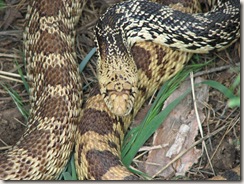
For some reason, as I drove home Friday, I wasn’t thinking of snakes. My mind wandered, and I had to slam on the brakes near our driveway to avoid hitting a nice young 3-foot Bull Snake. Time to start carrying a stick in the car again for moments like this. I found an old stalk of yucca and spent a few minutes encouraging her to leave the right-of-way where she preferred to bask in peace. Should have just picked her up; the bite is harmless and not that painful, and she seemed mellow, but why court trouble? By the time I returned with camera a few minutes later, she had disappeared as silently as is usual. [No, I have no idea whether she was really female, but one has to choose, “it” is just impolite.]
Happily, another opportunity presented itself later in the afternoon. We were sitting in the backyard when the Husband picked up the sound we dread. Rattlesnake! Starbuck, the snake-pointer, heard it too; he went on alert, showed us the spot, and barked to let us know he was holding this intruder at bay. (He has a special bark just for unusual occasions, most often a snake. He's also turned up one box turtle and one tomato worm. Very exciting.) Husband checked, diagnosed “No, Bull Snake,” and we all breathed a sigh of relief. Once the dogs were inside, we got a closer look at my second bull snake of the year.
I like rattlesnakes too, long as they’re not sneaking up on me! I like to know where they are. Rattlesnakes are, of course, one of the few reptiles that let you know where they are. Sometimes. I bet 90% of the rattlers I encountered when I lived in Arizona never made a sound. My theory is that rattling, these days, is behavior that can cause you to lose your head, and thus we humans have been deliberately selecting for rattlesnakes that prefer not to rattle. That’s why it pays to keep your eyes open too. Here's a prairie rattler recording, for reference.
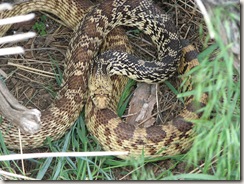
As long as we can see the whole snake, or most of it, a little attention to detail increases our comfort. The overall gestalt that says Bull Snake includes a long streamlined body (as opposed to the stockier form usual in rattlesnakes), a narrow innocent-looking head blending into a neck of similar dimension (unlike the so-called “triangular” head and narrow neck of rattlesnakes), and tapering pointed tail (rattles blunt the tail tip, even in young rattlesnakes). Stocky is relative. Bull snakes are our biggest snake here in Colorado, so they can get very hefty when they reach a length of 5 or 6 feet (1.5 m or more). The girth of this one was probably 7 or 8 inches (17-20 cm). A rattlesnake that big around would be much shorter, maybe 3 to 4 ft (1 m). Of course, rattlesnakes’ eyes also have vertical pupils, unlike the round ones in the mimics, but do you really want to get face-to-face with one to check that feature?
Most people are willing to believe any patterned snake is a rattlesnake. This little baby Yellow-bellied Racer (Coluber constrictor mormon) was found at the local
These guys are even called “pugnacious” in the guidebook, so it’s easy to believe, again, that you’re dealing with a dangerous predator. Even at 15-18 inches (+/- 40 cm), this little fellow was a handful. Jace at Nature Journals describes the rattlesnake-mimicry racers will perform. I’ve never seen them tail-buzzing myself, but then I’ve never tried to confront one in the wild as he describes in his last paragraph. For a nice collection of photos of juvenile and adult racers visit California Academy; the adults are completely different. After our photo-op, we returned this little guy to a safe place a little farther from the school.
Diagnostically speaking, note the narrowness of the neck compared to the head, and the black tail near the rattles.
The rattlesnake I encountered at the chicken coop last summer was a clear green. Just lovely… as long as I knew where he was. Thankfully, that one did rattle at me. To this day, I still expect to see him every time I go out there, now that it’s spring.
By the way, a good resource for Colorado reptiles and amphibians is the Colorado Herpetological Society, especially their identification guide. Extensively updated since my last visit, it’s a great site.
Friday, May 22, 2009
Live at the Bear’s Lair
On our second trip to Lair o’ the Bear last week, we never made it to the jelly lichens, but we did get a good look at two beaver dams and dozens of wild bloomers.
A main attraction was the Mountain Ball cactus (Pediocactus simpsonii), in full bloom on a rocky bend in the trail. I think this is the best looking cactus we have in our area.
This garden-like view of wildflowers on a dry slope includes Sand Lilies (Leucocrinum montanum) in white and Oregon Grape (Mahonia repens) in bright yellow on a background of fringed sage (Artemisia frigida).
Here’s a close-up of a Sand Lily. In these spring plants, the ovary is below ground level, so the pollen tube has a long way to go to reach it. The seeds mature underground and later get pushed out onto the surface where they can germinate.
Short’s Milkvetch (Astragalus shortianus) is about the earliest of our many milkvetches. Its two-tone flowers are distinctive, but it’s the timing of bloom that helps, with other species of milkvetch not ready this early. (This year “early” is coming a few weeks late; the sand lilies should have been gone by now.)
The Lair is a riparian park, as we’ll explore more tomorrow, and shady spots near the stream are great locations for Canada Violet (Viola canadensis). Or maybe not—looks like Bill Weber now calls it V. scopulorum, V. canadensis being an eastern species. There’s also a similar species, V. rydbergii. I didn’t diagnose, so perhaps I should just call it Violet to be safe! (Other sources consider both of these subspecies of Canada Violet.)
Golden Smoke, Corydalis aurea, is easier, as it’s the only representative of its family we’re likely to see in our foothills. It’s related to the eastern Dutch-man’s Breeches, and to Bleeding Hearts in gardens, and has the unusual flowers typical of the Fumariaceae.
Serviceberry, one of my favorite shrubs, is a special treat. It’s not quite as abundant, it seems to me, as others in the Rosaceae, which sometimes seems to be our dominant woody family around here. Amelanchier alnifolia, also known as Saskatoon Serviceberry, is one of many species native to and widespread in North America; we also have Utah Serviceberry, A. utahensis, which has shorter petals. It’s called serviceberry because it’s so useful—tasty fruits look a bit like blueberries and are eaten fresh or dried by most tribes, as well as anglo settlers who came later. From pemmican to pies, berries have been prized, but the wood and twigs were also used in basketry, arrow shafts, and tools or toys. This attractive shrub is serviceable in the landscape as well, and often available at nurseries.
I tried to capture the Pasqueflowers (Pulsatilla patens) that were everywhere in the park, but somehow failed to get a good shot of any of them. Bee Lady’s husband Dave, an excellent photographer, really focused on them, with great success. I’ll let you know when I talk him into having his own blog!
Coming soon!
Next up, some of the critters
we saw during this visit. Bee
Lady made a wonderful guide;
she knows all the park’s
secret places.
Thursday, May 21, 2009
Morning Scold; Power of the Internet
Yesterday I received constant scolding from the magpies when I went to feed the chickens. As I bent to fill a feeder, I heard clumsy flapping above me. No wonder it was so noisy! Three baby magpies just over my head, holding tight to the branches of their chosen security tree. Must be the first day or so out of the nest.
Same thing today… it’s bad enough to get scolded by Orioles when the hummingbird feeder runs dry, but now this! Here are 13 seconds of magpie scolding for your listening pleasure. I was lucky—my cat just looked at one of the babies strolling on the ground, and the parents chased him straight out of the yard. Parent on the right, babies hidden among branches in photo left. Can you see the 3rd one below the others?
Because the babies are huge, and closely resemble the parents, you might want a couple tricks. I have two: the shorter stubby tail compared to the adult’s flowing one, the only long-tailed bird in most of the U.S.* And baby lips, nicely displayed in this portrait of baby #2.
As far as I can tell, the parents aren’t feeding them, just keeping an eye out that they’re safe.** The babies are trying to figure out the sunflower and suet feeders.
In fact, it’s a complete zoo out there. Feathers zooming around everywhere, yellow, orange, pretty amazing. Here’s a quick inventory, some of which will have to be added to the May bird list.
To be honest, some of them aren’t zooming, they’re walking around looking for whatever it is towhees and doves and such look for.
Right now, in the yard:
- Bullock’s Oriole, 2 males, 1 female
- Black-billed Magpie, mom, dad, 2-3 kids
- Scrub Jays, 2
- American Goldfinch, male
- Spotted Towhee, 3
- House Finch
- Mourning Dove, 2
- English Sparrow, male
- Broad-tailed Hummingbird, female
- Common Grackle, 1
Darling Husband, just back from Moab a few days ago, was just commenting on how nice it is to be back amid all our birds! (And we still have some green on the hills, too!) I guess the desert was pretty quiet compared to our yard this time of year.
Power of the Internet
Tuesday I had a powerful reminder of how not-alone one is online. Sometimes it seems pretty quiet here in blog-land, but within hours of posting the Jelly Lichens story, two interesting things happened. First, I got an email from the lichen curator who discovered the new lichen I mentioned. Very cool of him to stop by, but I can’t figure out how he found out I mentioned him. Second, in attempting to figure out how he discovered the post, I googled “jelly lichens,” and, imagine that, my post came up #5! Right after something called arkive.org and the USDA Plants profile (who knew they had lichens!), and ahead of my favorite lichen site, Lichen.com. I’m still baffled.
So, just remember, next time you google some obscure term or phrase, you could end up at the blog of some highly authoritative fancier of the item in question!
——
* According to my book, if you're in Texas, you might also get to see the Scissor-tailed Flycatcher; the Fork-tailed Flycatcher occasionally visits Florida. The rest of us will have to make do with Magpies. By the way, "long" in this case means longer than the body.
** Wrong again; the parents are still feeding them. Finally witnessed it late yesterday. See what I mean, authoritative! [grin]