Friday, April 28, 2006

Here we go again...

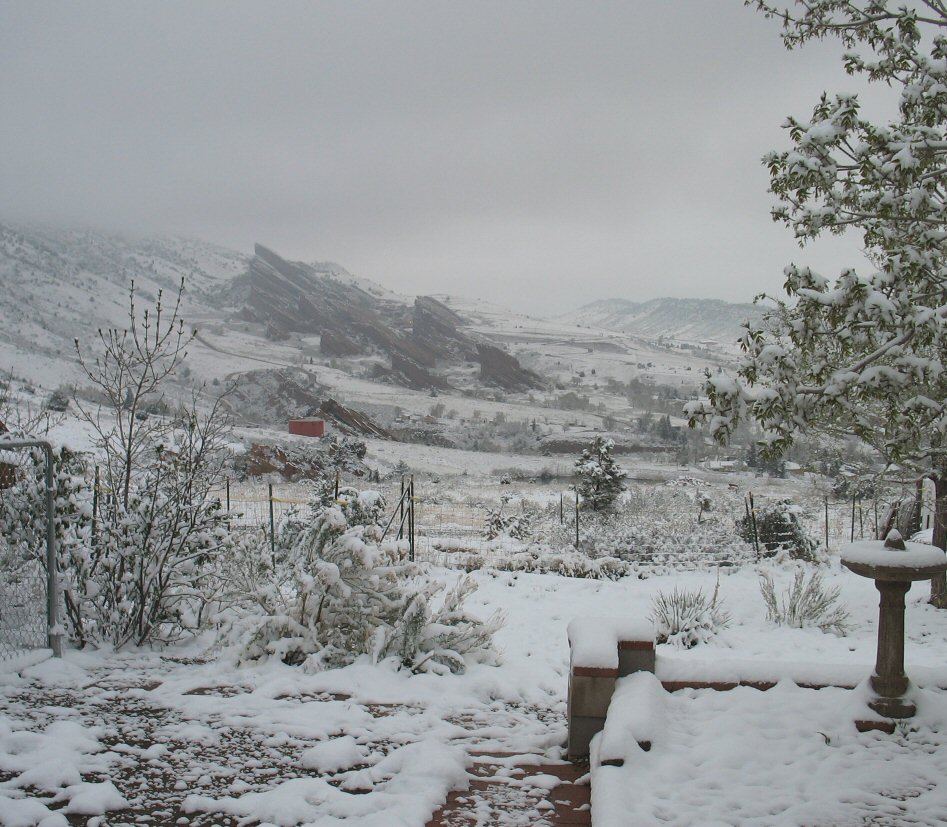
It's beginning to look a lot like Monday afternoon out there. See April 07 for photo, I'm not going to do this again! Juncos and hummingbirds are happily (?) coexisting outside, as the temperature hovers at 38 degrees and the flakes keep getting bigger. At least it's wet and, as we Coloradoans always tell each other, "we NEED the moisture."

Wednesday, April 26, 2006

Lilac Snow

Tuesday (yesterday) morning, 6:30 a.m.


On Sunday it was 80 degrees; I actually considered putting on shorts, got a little sunburn. By Monday night, I was worried whether my lilacs would survive. This is what they looked like Tuesday morning.
A little late for "daffodil snow" this year, we ended up with a real "lilac snow"... and I scraped more than 3 inches off my car yesterday morning.

(Essay on spring snow season...)

Ahhh, Colorado! This a.m., temp is already approaching 44 degrees, and the sky is bright and sunny. Per usual. Mild surprise--the lilacs seem to be coming back to life. The blossoms on the Italian plum and apple will probably be gone; all the flower buds on the green ash trees fell to the ground. The ashes will have to put out a new set of leaves; tender new ones have frozen. Never even saw an apricot blossom this spring; they were killed long ago by one of our cold spells. What about the wild plums? Will their flowers weather the weather better than our introduced fruits? The bears hope so...

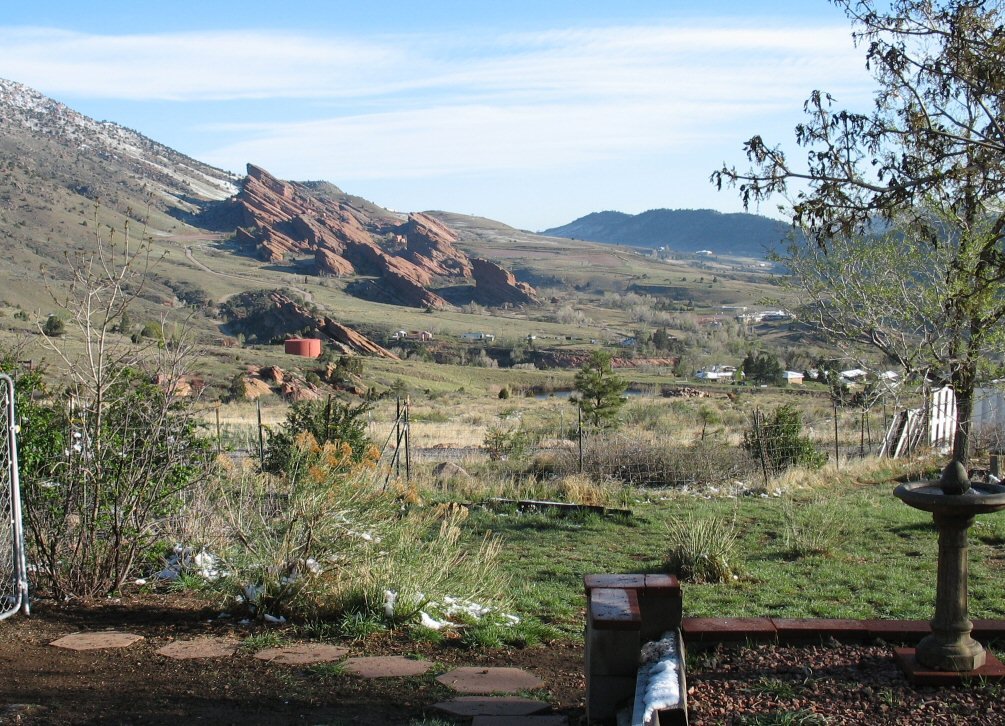
Here's this morning, for comparison.


Just a few spots of white stuff left-- It's as if the world has gone from black-and-white to color!

Valley Birds

Yesterday morning we sat in Lila's sunroom in Morrison, just 200-300 vertical feet downhill, and watched the birds at her feeders. A lazuli bunting, blue as today's sky, showed up! Also a red-breasted nuthatch, somebody I hadn't seen before. But she lacked our white-crowned sparrows and goldfinches. What a difference a mile makes! Here on the hill, we still have juncos, our winter pals.

Saturday, April 15, 2006

Across Colorado

Just a quick note to say that I'm off on the West Slope, so will have an excursion report when I return in a few days. It's snowing this morning on Hastings Mesa, the Stellar's jays and magpies are hanging out in the tree tops looking for handouts. Bears are out of hibernation, one was spotted this a.m. Lots to tell when I get back!

Friday, April 07, 2006

Spring Snow...

It's only been a half-hour, but the snow "flakes" (more like balls) are now almost 3 cm in diameter. Very cool!

Gray Day Turns White

As I was saying to the Husband this a.m., "looks like there's moisture in the air out there." Green Mountain in the distance was obscured by a hazy film suggestive of air you can't quite see through!

Then, it rained for a little while. How exciting! Rain is a relatively rare event here--yesterday I virtually did a rain dance in the parking lot at the office because there were sprinkles on the pavement. But today, actual rain was slanting down.

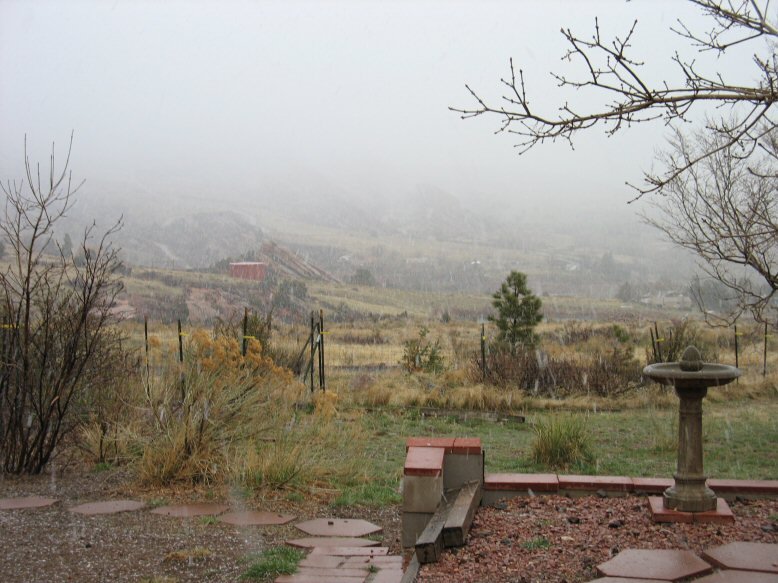
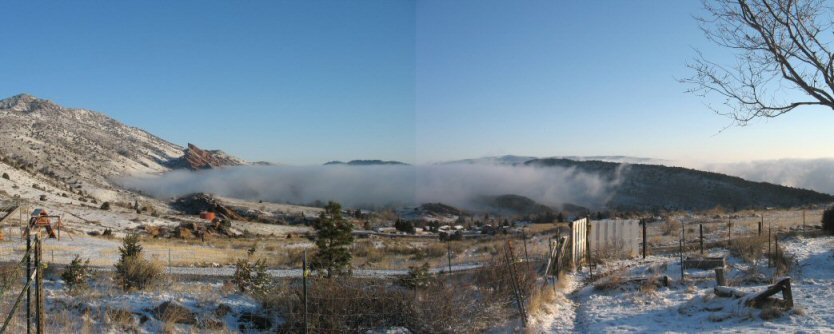
Now it's turned into fat white globs and is pelting gently down. I neglected to check the temp when I got up, but it's currently hovering at 38. Balmy. Here's the view as of 7:39 a.m. The white globs will show up better if you click on the picture for a larger version.


Yes, that's Red Rocks in the distance. And what's that in the foreground? Can it be? Yes, I think... it's... GREEN!

Wednesday, April 05, 2006

Nature in the News...

Every once in a while, Nature does make the news. How rare this is (apart from drastic weather) seems to be a measure of our distance from the natural world. Today we have two posts about Nature in the media.

Unfortunately, it seems to me, the evening news-- along with most of our society --only notices Nature when human plans or goals are being somehow interfered with—hence the “pesky” flickers, below. Have you noticed how often we remark—and resent—these small signals that events in Nature are healthy, that reproduction is still going on?

Pesky Flickers!

The bunnies aren’t the only ones feeling hormonal surges. The Husband reports that even the evening newscast picked up on the fact that flickers are also exercising their territorial and courtship prerogatives lately. It’d be hard not to notice, when almost every time I step outside, the sound of drumming is in the air.

Given more to solitude than flocking, flickers were forced to develop long-distance communication. Living close to hollow trees, male flickers took to drumming to attract the female during those seasons when togetherness is called for. Ah, spring! So here they are, in town and country, finding our hollow houses and chimneys more than adequate substitutes for the growing shortage of hollow trees. At least that’s the way it looks to me.

People tend to notice large woodpeckers pounding on their houses, especially early in the morning. Even people who ordinarily aren’t too attuned to Nature get the message. Rejoice—it’s spring!

One of our resident flickers took to drumming on a bluebird house we’d installed years ago. (Hope it wasn’t occupied.) Evening before last, we were pleased to see that he’d had some success—two flickers were chatting in the big elm tree. Bobbing heads, making a new (to us) flicker noise. Not the common call or alarm clacking as they fly, but a more subtle sound, the cooings and murmurings of growing affection. Can young flickers be far behind?

March Madness

I meant to write about March madness, and here it is, April already! The cultural form of March madness is over. I remotely sensed it had something to do with basketball, but fortunately I got to witness its origins in my front yard, so I have a better understanding of the etymological roots of the disease.

Beyond the temptation of alliteration, March madness has a fine pedigree, dating to 1546 according to Wikipedia. The phrase might have died out long ago (along with “mad as a hatter”) had Lewis Carroll not reinforced it in 1863 in Alice’s Adventures Underground, beloved to modern readers as Alice’s Adventures in Wonderland, and thus ensured its continuity into the present day.

Why is the March hare mad? First, recall that “mad” comes down to us mostly as a synonym for insane, senseless, illogical. Only later did it develop its current common use as angry.

In short, the March hare has spring fever. Clearly March madness has something to do with those passions that erupt in spring, as the breeding cycle begins. Our local cottontails are always a bit impulsive, dashing under cars and such—but last month they were truly senseless, more willy-nilly than ever, and seemingly without provocation.

One morning I looked out to see a pair of cottontails chasing each other. Finally one stopped short, stood up, and boxed at the other, all part of the March madness, I assumed. Sure enough, says Wikipedia, “unreceptive females use their forelegs to repel overenthusiastic males.” So perhaps the poor male March hare, a rejected suitor, has reason to be angry as well as “mad!”

Tuesday, April 04, 2006

Feeder Cam

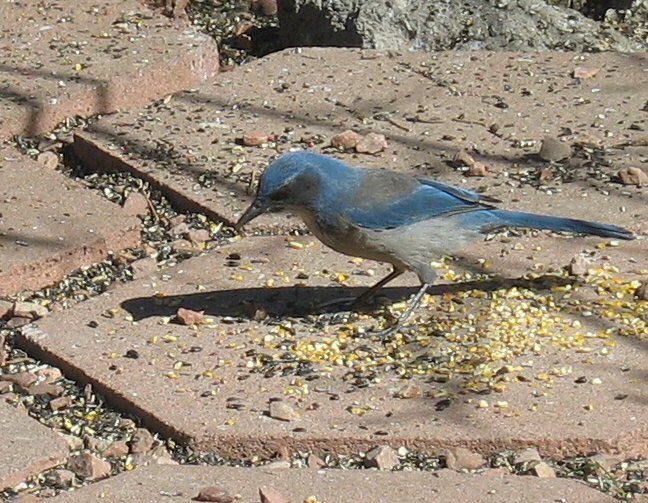
Another visitor to add diversity to the birdfeeder watch this a.m. I don't know what it is with these little birds, but we have noticed them much more frequently in recent years. When we first moved here more than 20 years ago, we never saw any of these. Must signal some change in migration patterns.

Here he is-- forgive the photo quality. It's a gray day today (we're hoping for rain), and I didn't dare open the door for fear of spooking this new visitor so I shot it through the glass. (Doubtless my photos would improve if I'd just wash the windows, but what fun is that?)


Our rehabber friend CarolG has better bird stories than I do, so I think I'll work on a new piece for my neglected history blog this morning. For a good bird story, featuring bunnies from the inside out, see her comment on yesterday's post. Warning: content may not be suitable for bunny-lovers, but is a great read for those who take the bird's perspective. It's sad that CarolG has no time to start her own blog--but fortunately my posts seem to inspire her! Thanks, Carol...

Monday, April 03, 2006

Speaking of Predators, part 1

When we first got chickens (back in 1996), I knew we’d be getting better acquainted with local predators. I just didn’t know which threats would prove the biggest challenge. We used to have lots of skunks, for example—but they seemed to get along fine with the chickens, even developed a taste for the feed, alas. We still occasionally smell skunk around or under the coop, but they have not been a threat. Raccoons, foxes, no problem. We’re too far from water for regular raccoon sightings, and foxes have rarely put in an appearance. Knock on wood.

April is the time of our annual visits from predators, so this month always makes me nervous. It’s spring, everyone’s either got babies to feed or is looking forward to having babies to feed. It’s a hungry time of year, I understand that. I also get that we’ve become members of the local ecosystem and have to pay our dues. So today’s chat is a bit grim, but not gruesome, I promise. I won’t inflict the entire reality on you.

The first deadly visits we had were a surprise—they came from the air. Chickens are very alert to anything that moves in the air, and will give the alarm whether the object in question is a pigeon, or hawk, or airplane. (They are a wonderful aid to bird-watching: as soon as I hear this special sound, I look up and am usually rewarded.) A small hawk perching nearby, as Artemis does, makes them nervous but doesn’t unduly alarm them. Perhaps they know somehow that she’s after smaller game.

In the early years, the chickens used to have the run of most of the open front yard. That changed in April 2001, when one of the local golden eagles discovered them. One night we came up short on the evening “beak count.” It snowed, though, so it was a day or two before it melted off and we found the evidence. We couldn’t be home all day, and the eagle returned about weekly for awhile. I think we lost about 4 chickens in all. We finally got smarter, and built a new fence to confine the chickens in a smaller space that had more tree and shrub cover. Eagles can’t maneuver well in tight spaces.
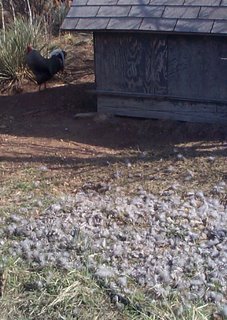
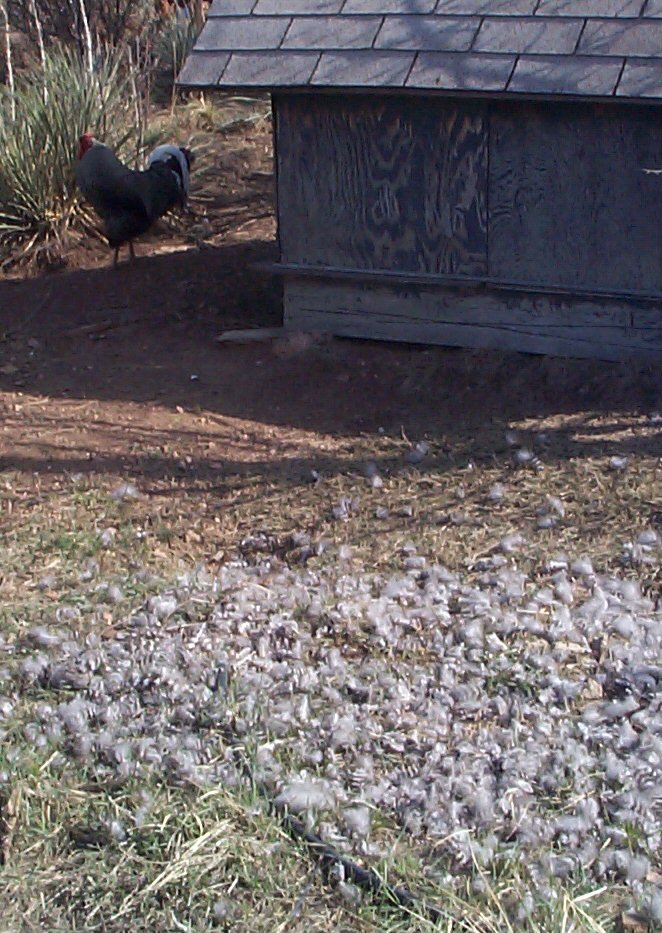
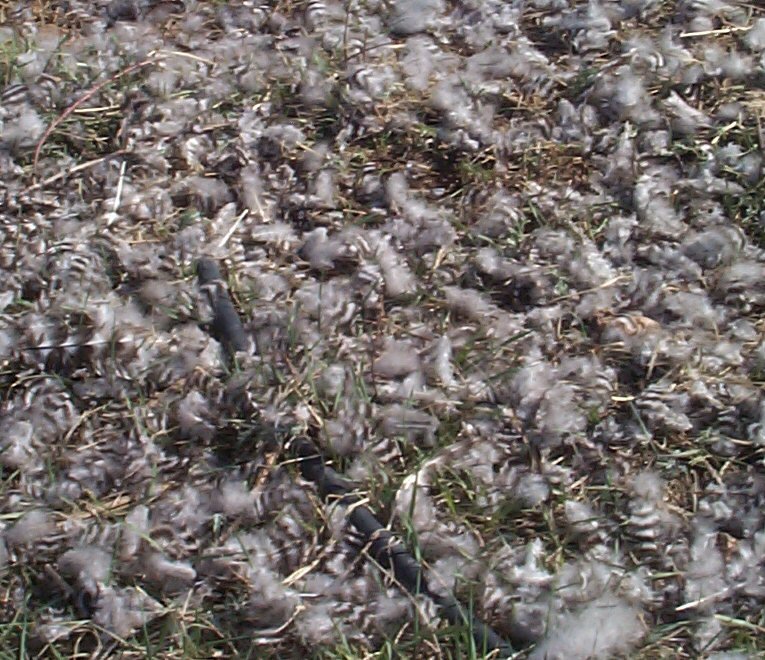
Barred rocks are one of our favorite breeds. The hens are sweet, friendly, productive, and hardy—you can’t ask for more. This is what a barred rock looks like after an eagle is done with her. (Note there’s a live barred-rock rooster in the background.) Very tidy: no body, not even a speck of blood.

This neat circle of feathers is, by the way, a prime way to tell a bird kill from a carcass killed by a mammal, as the latter usually don’t bother to pluck their prey. If they do, they pull the feathers out in mouthfuls, so you generally find clumps stuck together by saliva. Given time by my absence, the eagle carefully plucked each kill, presumably ate at leisure, and carried off the remains of the meal. Back to the babies.

The difficult times are when you hear the alarm and, roused by continued squawking, run outside to see what’s the matter. That, of course, spooks the eagle, who promptly takes off. You’re left with a dying bird, and the eagle still has to find lunch elsewhere. That’s a no-win situation. Much cleaner if you can muster the restraint to stay inside until it’s all over.

Sunday, April 02, 2006

Two-Coyote Morning

Always a good idea to look outside before letting the dogs (or chickens) into the yard. Sure enough, there was a coyote on the rocks just to the north of our property fence. Just ambling through, checking to see if she could find any mice in the rockpile. Sniffing along, wandering through the grass, after several minutes she disappeared down into a nearby gully.

Finally I let the dogs out, then turned the chickens loose into their yard. The dogs did find a rabbit, who made a wrong turn but managed to get through the fence after a brief but merry chase. Then a second coyote wandered down the drive along the east fence, exciting the dogs to new levels of enthusiasm and making me wonder whether the fence would hold them. Unperturbed, the coyote moseyed past, secure in the artificial distance the fence added to the 20 feet that separated him from the dogs. Although he too soon disappeared over the immediate horizon, the dogs remembered him for a long time, staring off in the direction of his departure.

Coyotes doubtless visit here more often than we actually see them, although one morning we woke to see a couple about 10 feet from the front door, eyeing the chickens and drooling. They slipped through the fence, no problem, when the dogs went out—but that was too close for comfort!

One morning two weeks ago, I saw the coyote walking by along the same fenceline. She checked the deep grass by the drive, froze, pounced, then came up with a mouse that she downed in one gulp. Breakfast? No, only a snack. She continued on across the neighbor’s back lot, circling and sniffing, then back to our fence, where she found another rodent. More of a two-bite size, it took her a few seconds more than the first. The magpies closed in, but she left them nothing.

I once thought getting to observe an act of predation would be extremely rare, but it is merely unusual.

Friday, March 31, 2006

Red-wings

They can be crockery, shoes I believe, even prisons—but today we are talking about, of course, birds! We occasionally are visited by large flocks of these noisy, colorful blackbirds. They fly in, land and devour any sunflower seeds they find, and take off again.

I should mention that we are at 6100 ft here, and a fair distance from a marsh or sizable wetland. High and dry.

I just found a reference that may explain how these successful little opportunists are managing. Writing in 1969, Paul Sears tells us:

“And the red-winged blackbird, previously known as a creature of swamp and marsh, has behaved in a most unorthodox fashion. Instead of politely vanishing as its customary home was done away with it is now nesting in soy bean fields and it has turned its attention from waving reaches of rush and reed to not dissimilar fields of ripening grain. Particularly given to tearing open the tender tips of green corn, the red-wing now ranks as a major pest. Usually we are indebted to foreign lands (as they are to us) for destructive imports. … But the versatility of the red-wing is proof that we can grow our own trouble-makers—always provided that we upset the old balance sufficiently.”

(from Lands Beyond the Forest, Paul B. Sears)

With all respect to Paul, one of America’s eminent ecologists, I don’t think I’m going to be able to consider red-wings as pests—but then, I have no fields of corn to defend. I am, rather, delighted to know that somebody can learn to profit from the messes we are making of our environment, and that some natives will survive in our highly modified world.

And I’m captivated by the concept that any small patch of wetness attracts cattails like a magnet. And that any small patch of cattails automatically generates red-wings. What would spring be without their trills?

Thursday, March 30, 2006

Many Happy Returns: Migrants come back

There is a short report this a.m. after all, as this is a good place to start recording who we see and when. (I keep putting records in notebooks then losing track of them!)

Yesterday, a white-crowned sparrow. He was here a few days ago too. Seems to be only the one so far, though we never see them in large quantities.

Have to dig out the hummingbird feeders this weekend. One year, a hummer showed up unexpectedly--in an April snowstorm, hovering exactly where a feeder had hung the year before. Better to be prepared.

And, one unhappy return, a dead hawk on a roadside yesterday. I'm pretty sure it was a Swainson's. What a shame to have such a sad first sighting.

I and the Bird, #20

The new issue of the bird-blog carnival, I and the Bird, has been posted by Nuthatch. Lots of good reading here, and Foothills Fancies is even featured on it.

My blog time this a.m. will be reading instead of writing. Check it out: I and the Bird!

Back tomorrow!

Wednesday, March 29, 2006

Birds of Prey Foundation

Quick update, to let you know that the new west-side rehab person I encountered in the Scrub Jay story below is Carol Goldstein, of the Birds of Prey Foundation in Broomfield. This organization --and its very dedicated people--does great work! And, as most nonprofits, they always need donations. Besides the much appreciated dollars that help them do their work, they also have a wish list of items they need to help the many birds they care for each year. If you can help, please let them know.

Carol is new in the area, but fortunately for me--and the young scrub jay--she has great background in songbirds as well. She can be reached via CoRaptorRescue@hotmail.com.

Migration's coming...

It really feels like spring out there this morning, and with that comes the realization that one morning I'll wake up to No Juncos! Birder buddy Carol tells me some of them do in fact stay around, but not in my yard. Perhaps they go west, to higher ground.

This morning things were pretty bare out there, so I went out to throw some seed around. Most of it goes on the ground these days. The juncos seem to prefer it, and the others apparently don't mind a bit.

Dozens of birds scattered. As soon as I came inside, a scrub jay was back within THREE seconds, a sparrow within 10. First junco hit the ground a full minute later, and now the hordes have descended.

We'll miss the juncos, but look forward to welcoming back old friends: black-headed grosbeaks, hummingbirds, and many more happy returns to chronicle in the weeks ahead.

Tuesday, March 28, 2006

Lining up for breakfast


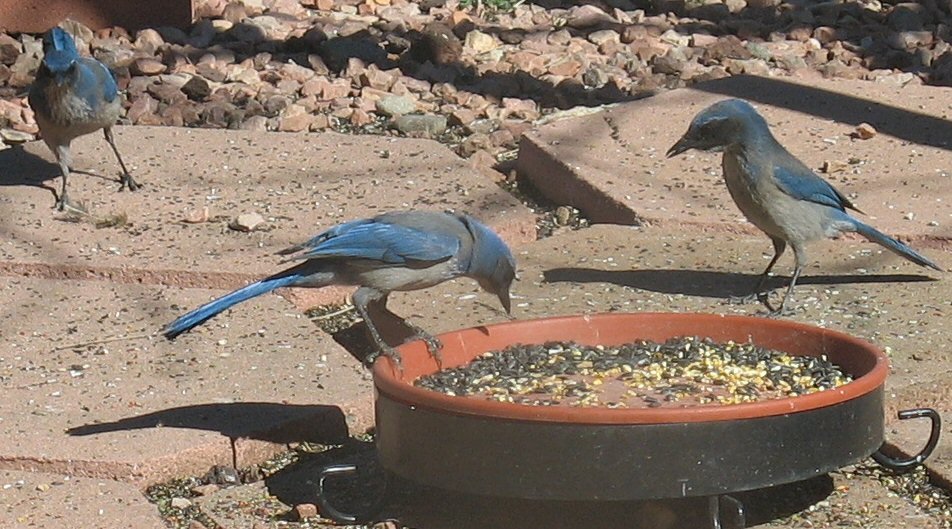
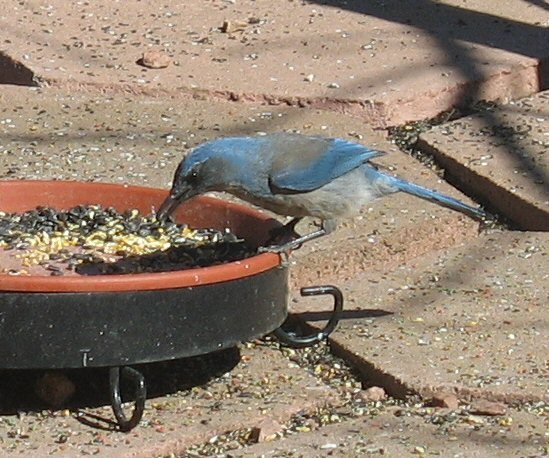
Here are the scrub jays. Finally caught them in action, removing all the sunflower seeds from the mixed assortment offered this a.m.


It doesn't take them long to get all the best seeds, only leftovers for the others.
Scrub jays usually stash most of the sunflower seeds--and dog food when they can get it--for another day.


Foul-weathered friend
While Artemis was here, we didn't see many scrub jays at all. She still stops in briefly, to see what's going on, but apparently has moved on to other hunting grounds now that the snow is gone-- much to the relief of the feathered flocks.

A Scrub Jay in the Hand...

One morning a local fireman, responding to a call, called me a magnet for trouble. Long story I won’t go into here, but after feeling a bit put out at first, I’ve decided it’s a compliment. Critters (more rarely, people) in trouble do tend to show up on my doorstep perhaps more often than should be expected.

A couple weeks ago, when I went out to feed the chickens, I noticed this scrub jay sitting near the feed tray, somewhat distressed. Seemed to have something stuck in his beak. Okay, says I, if he doesn’t fly away, must be he needs help. Sure enough, he was completely passive, so I put him in a cage and started making phone calls.

The only rehabber I knew was far out on the other side of Denver, so I was delighted, after a single call, to be referred to a new one much closer. Off we went, on a slightly snowy morning, to meet her at Big O Tires. She took one look at the jay’s somewhat moribund state, and started fishing in her purse for something to substitute for proper equipment. Found the top piece of a classic Bic pen, and used that to see what was in the little guy’s mouth and sweep it out. In shock, he laid on his back in her hand while she retrieved one caterpillar more than an inch long (dead), some dirt clods, a chunk of corn, a milo seed, and assorted other gunk. I left, she rinsed his mouth a bit, and took him on home to recuperate. Neither of us was very optimistic.

By the time she got home, she told me later, he was jumping around in the box. She put him in a bigger cage, but he threw himself around so persuasively that she was concerned he’d hurt himself. By then, he’d had a little to eat and drink and seemed pretty well recovered, so she let him go in the garage, where he perched for a while. Finally he flew out the open door and sat in the top of a big pine tree for 45 minutes, preening and resting. Then, whoosh, off he went, flying into the storm, back down the hill—back toward home, she said.

We were both pretty excited I think, as not all rescue adventures end so happily. But for all those out there doing this work, so rarely rewarding and generally without compensation, please know how nice it is to find someone to turn to, someone who will help! A hearty thank-you from the rest of us, who lack the nerve and training and competence to even attempt such delicate work!

Monday, March 27, 2006

Best Botany Blog

One of the first blogs I discovered, back last fall, is still my all-time favorite.

The Botany Photo of the Day is published by the Botanical Gardens at the University of British Columbia. It's a great place to see wonderful images of everyday plants, as well as exotic species I will likely not get to see in real life. The site is managed by Daniel Mosquin, and I can't recommend it more highly.

By the way, if you're really interested in plants or ever have a question about them, see the Forums on the same site. Forum members can identify almost anything, virtually instantaneously.

Botany Sidebar: The spring blizzard of 2003 (previous post) did wonders for the variety and abundance of spring wildflowers and sustained most of our vegetation well into the summer. Or so it seemed. March is usually one of our snowiest months and provides a great deal of our moisture. So far this year, though, we are on the dry side. As spring progresses, we'll include local wildflowers here.

Saturday, March 25, 2006

Anniversary Remarks

As weather is one of the truly fun things to observe here on the Front Range, I didn't want to let the anniversary of our big blizzard pass without comment. Three years ago last week we had the biggest snowfall since the blizzard of 1913. It was a once-in-90-years occurrence, March 18-20, 2003.

To commemorate it, here's a photo of the hubby taken while we were out shoveling. Five feet in total; Red Rocks in the background, as always.

And it could still happen again this year!

The Pied Junco: Nature and the Individual

I confess I'm little embarrassed about naming the hawk last week. Long conditioning suggests that “scientifically speaking,” it just ain’t right. (Thank goodness we’re not speaking scientifically!)

So I thought I’d share some random thoughts about the individual in nature.

Biologists like to think in terms of species, the members of which are pretty much indistinguishable cogs rollin’ along on the wheels of evolution. No, that’s not it. Biologists know that each and every individual (in sexually reproducing organisms at least) is genetically distinct, it’s just that they believe the important thing is the species, or the population, but never the individual. I always had trouble with this concept in school. I mean, if every individual grizzly bear or Pawnee montane skipper dies, that’s pretty much it for the species as well.

Trouble is, most of the time it can be pretty hard to tell one mule deer or crawfish from another. Partly because we’re not looking closely enough, and with wild animals it can be difficult to look closely. And partly because they can in fact look pretty uniform. An individual would have to be remarkable in some way—we have to be able to distinguish him or her from others of like kind. Ornithologists accomplish that by banding birds; herpetologists clip toes; mammalogists use tags or toe clips; cattle ranchers might use numbered ear tags. All to make the individual songbird, lizard, mouse, or cow unique and recognizable.

We concluded, based on repeated observations and a few markings, that we are seeing the same sharp-shinned hawk several times a week. Behavior is the most convincing reason—“she” uses the same perches, same hunting habits, whenever she visits. Could I recognize “Artemis” in a side by side comparison with another immature hawk of her species? Doubtful.


But the pied junco (left, with a normal individual of slightly different color pattern), yet unnamed and likely to remain so, is visibly unique. He or she, let’s say he this time, is a “dark-eyed” junco of the color pattern that used to be known as the pink-sided race of the Oregon junco. Except for his white-blotched head. That sets him apart from his peers. Every time he visits, we will know he’s here as soon as we spot him, but his companions will remain anonymous no matter how familiar they may be.

We'll continue this another time...

Thursday, March 23, 2006

What Denver doesn't know...


is that it's a gorgeous sunny day today. Denver is to the far right of the above photo, under the branch, hidden in fog at 6:45 this a.m.

Foto frustration this a.m. blogging. Thanks go to birdchick for posting pointers on pictures on her blog today!

Artemis checks out the thistle feeder...


She really can't figure out what the attraction is!

Artemis sleeps in...


Yesterday, she didn't show up until almost 9 a.m., giving the little guys a good chance at breakfast. And she didn't stay long, as I had to go out to feed the chickens and that spooked her. She took off, and the air was all a-twitter again!

We had a half-dozen lesser goldfinches, the usual complement of mixed juncos, several house finches, two chickadees, a towhee, and I did see a male starling at one point. The odd thing was that the scrub jays, usually daily visitors, had been scarce while Artemis stayed around, and were back in force yesterday. Several magpies also came by to see if I'd refilled the suet feeder (I hadn't!)...

Wednesday, March 22, 2006

Lesser Gold


Another bird note: The Lesser Goldfinches returned last week, about Thursday I think. Little tiny things! Aldo Leopold once wrote, about winter survival of chickadees, that "It seems likely that weather is the only killer so devoid of humor and dimension as to kill a chickadee..."

Lesser Goldfinches ought to be safe, then-- they are even smaller than chickadees! Hard to believe Artemis would bother trying to catch one. We had six or eight on the thistle feeders over the weekend, but once the storm moved in, they disappeared for a couple days.

Under the snow: Before the storm, I went out checking. Oregon grape hollies were blooming, and just a few Easter daisies. Spring beauties were just visible, with buds unopened. More to come!